











































Key Takeaways
- Call center stress stems from a combination of high call volume, difficult customers, strict KPIs, and limited control over daily workflow.
- Emotional exhaustion is the core driver of customer service burnout, not just workload volume alone.
- Chronic call center stress leads to measurable business costs: higher agent turnover, lower quality scores, and inconsistent customer experience.
- Structured stress management, realistic KPIs, real-time support, and healthy scheduling meaningfully reduces burnout.
- Prime BPO builds agent well-being directly into its operational model, which is why its outsourced teams retain talent and deliver consistent customer service quality.

Introduction
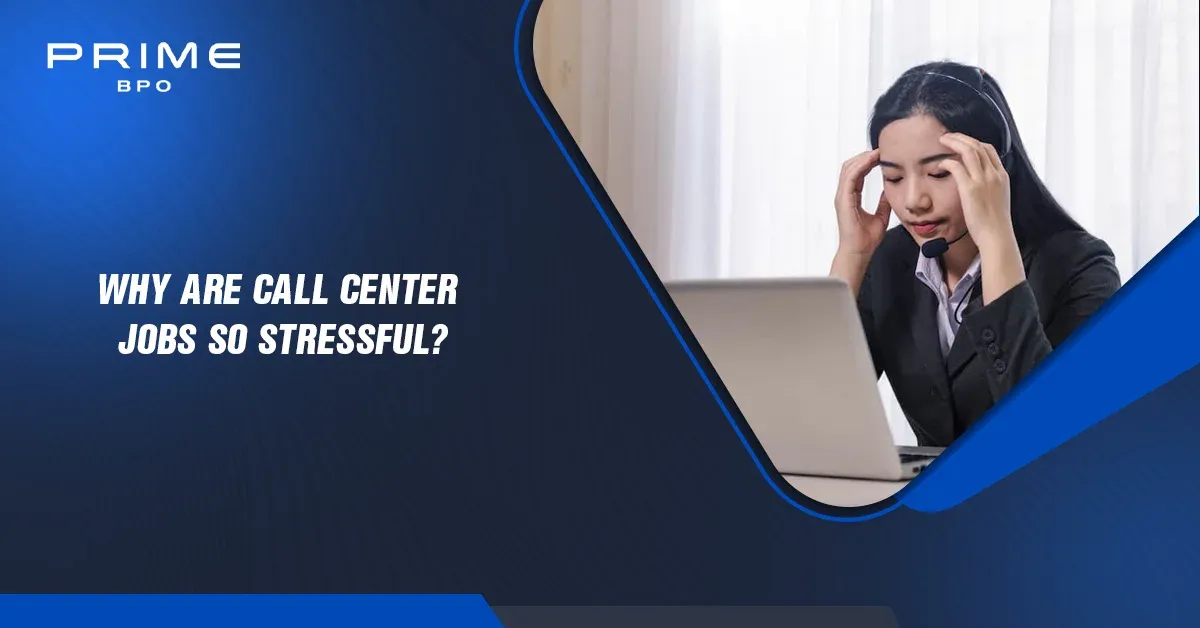
Ask almost anyone who has worked a customer-facing phone job and they'll tell you the same thing: the calls themselves are rarely the hardest part. It's the volume, the tone of the fifth angry caller in an hour, and the quota ticking down on a dashboard that make the job hard. Call center stress is one of the most well-documented forms of workplace stress in the modern service economy, and it's a major reason why call center agent stress and turnover remain persistent challenges for BPO providers and in-house support teams alike.
This guide breaks down exactly why call center jobs are so stressful, what drives burnout in customer service roles, the measurable business impact of that stress, and the stress management practices that separate high-performing, low-turnover BPO teams from the rest of the industry.
Is Working in a Call Center Really That Hard?
Yes, call center work combines high call volume, emotionally demanding conversations, and strict performance metrics in a way that few other entry-level jobs do, making it objectively one of the more mentally taxing customer-facing roles. The difficulty isn't usually the technical content of the calls; it's the sustained emotional and cognitive load of doing it repeatedly, all day, under measurement.
Unlike many roles where a bad five minutes can be shaken off before the next task, call center agents often move from one emotionally charged interaction directly into the next, with a supervisor or dashboard tracking how quickly they do it. That combination of no recovery time plus constant evaluation is what makes the job harder than it looks from the outside.
Why Are Call Center Jobs So Stressful?
Call center jobs are stressful primarily because of high call volume, exposure to difficult or angry customers, strict KPIs and sales targets, and a lack of control over pacing or breaks. Each of these factors compounds the others, which is why call center fatigue tends to build over weeks and months rather than appearing after a single hard shift.
High Call Volume & Repetitive Work
Agents frequently handle dozens of back-to-back calls per shift, often on tight average-handle-time targets. The repetitive nature of the work answering similar questions with limited variation creates mental fatigue even when individual calls aren't difficult, simply because there's no natural pause between them.
Difficult and Angry Customers
Support lines are, by design, where frustrated customers go. Agents absorb complaints, anger, and sometimes verbal abuse that has little to do with anything they personally did. Over time, this steady exposure to negative emotion is one of the most cited contributors to emotional exhaustion in customer service roles.
Strict KPIs, Call Monitoring & Performance Pressure
Metrics like average handle time, first-call resolution, and sales conversion are useful for measuring performance, but when enforced rigidly, they add a second layer of pressure on top of the call itself. Agents aren't just handling a customer's problem; they're doing so while a clock and a scorecard are running in the background, which is a major source of customer service pressure and anxiety.
Lack of Training, Support & Resources
Insufficient training, outdated tools, poor knowledge bases, and limited supervisor support can increase call center stress. Agents may feel overwhelmed when they are expected to handle complex customer issues without the right information or resources. Ongoing training, accessible support, and reliable tools help agents work with greater confidence and reduce unnecessary pressure.
Sales Targets Layered on Support Work
Many call center roles blend service with sales, requiring agents to resolve an issue and pitch an upgrade or add-on in the same interaction. This dual mandate creates conflicting priorities the agent has to genuinely help the customer while also hitting a revenue number, a tension that adds meaningfully to daily stress.
Long Shifts and Limited Autonomy
Long shifts, rotating schedules, mandatory overtime, and limited break flexibility can make it difficult for agents to recover between shifts. Unpredictable schedules can also interfere with sleep, family responsibilities, and personal time. Giving agents more predictable schedules, adequate recovery time, and reasonable flexibility can help reduce stress and burnout.
Low Pay, Limited Career Growth & Lack of Recognition
Low pay, limited promotion opportunities, and a lack of recognition can increase dissatisfaction and burnout. Agents who feel stuck in the same role may become less motivated over time. Fair compensation, clear career paths, and regular recognition can improve engagement, retention, and overall job satisfaction.
Get Free Quotes
Customized Options Await
What Makes Customer Service Agents Burn Out?
Customer service burnout typically develops from the cumulative effect of emotional exhaustion, lack of control, and insufficient recovery time not from any single bad shift. Burnout is a gradual erosion rather than a sudden event, which is exactly why it can be hard for individual agents (and their managers) to notice early.
Common warning signs include:
- Persistent fatigue that doesn't improve with a normal night's sleep
- Growing cynicism or detachment toward customers
- A drop in call quality or first-call resolution despite unchanged effort
- Increased absenteeism or lateness
- A noticeable dip in tone or patience during calls late in a shift
Left unaddressed, these symptoms typically progress into the outcome every BPO operator wants to avoid: agent attrition.

The Business Cost of Call Center Stress
Unmanaged call center stress doesn't just affect agent well-being, it directly damages employee retention, quality scores, and customer experience consistency, all of which hit a company's bottom line. This is where call center stress stops being a purely HR concern and becomes an operational one.
|
Impact Area |
Effect of Chronic Stress |
Business Consequence |
|
Agent Retention |
Higher burnout-driven resignations |
Constant hiring and training costs |
|
Call Quality |
Shorter patience, more scripted responses |
Lower customer satisfaction scores |
|
Absenteeism |
Increased sick days and no-shows |
Understaffed shifts, more pressure on remaining agents |
|
Training Investment |
New hires leave before reaching proficiency |
Wasted onboarding spend, slower team maturity |
|
Customer Experience |
Inconsistent tone and resolution quality |
Damaged brand reputation |
Industry data on call center turnover consistently shows attrition rates well above the average for other entry-level roles, and burnout is one of the most frequently cited reasons agents give when leaving. For BPO providers, this makes stress management not a soft benefit but a direct driver of ROI and service consistency for clients.

Call Center Stress Management: What Actually Works
Effective call center stress management combines realistic performance metrics, structured recovery time, real-time supervisor support, and a workplace culture that treats agent well-being as a performance driver rather than a perk. The most resilient BPO teams build these practices into daily operations rather than treating them as occasional wellness initiatives.
- Realistic, balanced KPIs Metrics that reward quality and resolution, not just speed, reduce the pressure to rush calls at the expense of genuine problem-solving.
- Structured micro-breaks Short, protected breaks between difficult calls give agents time to reset before the next interaction.
- Real-time supervisors support Easy escalation paths for a genuinely difficult call to reduce the sense that an agent is carrying every interaction alone.
- Skill-based call routing Matching agents to calls suited to their strengths reduces the frequency of interactions that feel personally taxing.
- Ongoing coaching over punitive review Feedback focused on development, rather than punishment for missed metrics, meaningfully lowers anxiety around performance monitoring.
- Predictable scheduling Consistent shift patterns support better sleep and recovery, both of which are directly tied to lower burnout rates.

How Prime BPO Approaches Agent Well-Being
Sustainable customer service quality is impossible to deliver with a burned-out team. That's why Prime BPO builds stress management and agent well-being directly into how its outsourced teams operate from realistic performance metrics and consistent scheduling to real-time coaching support and skill-based call routing. The result is a workforce that stays longer, handles calls with genuine patience, and delivers the kind of consistent customer experience that protects a client's brand.
For businesses evaluating a customer support outsourcing partner, agent retention and well-being should be part of the vetting conversation not an afterthought. A BPO provider with low agent turnover is, by definition, delivering more consistent service quality to your customers.
Curious how a well-being-focused BPO team could improve your customer support outcomes? Schedule a free operational audit with the Prime BPO team and see how a stable, well-supported outsourced support team can reduce turnover-driven inconsistency in your customer experience.
Conclusion
Call center jobs are stressful for reasons that are structural, not incidental: high call volume, difficult customers, strict KPIs, and low autonomy combine to create sustained emotional and cognitive load. Left unmanaged, that stress becomes burnout, and burnout becomes turnover, quality decline, and a worse customer experience. The BPO providers that treat agent well-being as an operational priority, rather than a soft benefit, are the ones best positioned to deliver consistent, high-quality customer service at scale.
Get Free Quotes
Customized Options Await
Frequently Asked Questions
Why are call center jobs so stressful?
Call center jobs are stressful because agents handle high call volumes, difficult or angry customers, and strict performance metrics simultaneously, often with limited control over pacing or breaks throughout their shift.
Is customer service a stressful job compared to other entry-level roles?
Yes, customer service roles tend to rank higher in workplace stress than many other entry-level jobs due to the combination of emotional labor, repetitive work, and constant performance monitoring.
What causes customer service burnout?
Customer service burnout is typically caused by cumulative emotional exhaustion, lack of autonomy, and insufficient recovery time between difficult interactions, rather than any single stressful shift.
How can call centers reduce agent stress and burnout?
Call centers can reduce stress through realistic KPIs, structured breaks, real-time supervisor support, skill-based call routing, and predictable scheduling that supports better recovery.
Does call center stress actually affect business performance?
Yes, chronic call center stress raises agent turnover, lowers call quality scores, increases absenteeism, and creates inconsistent customer experiences, all of which carry measurable business costs.