




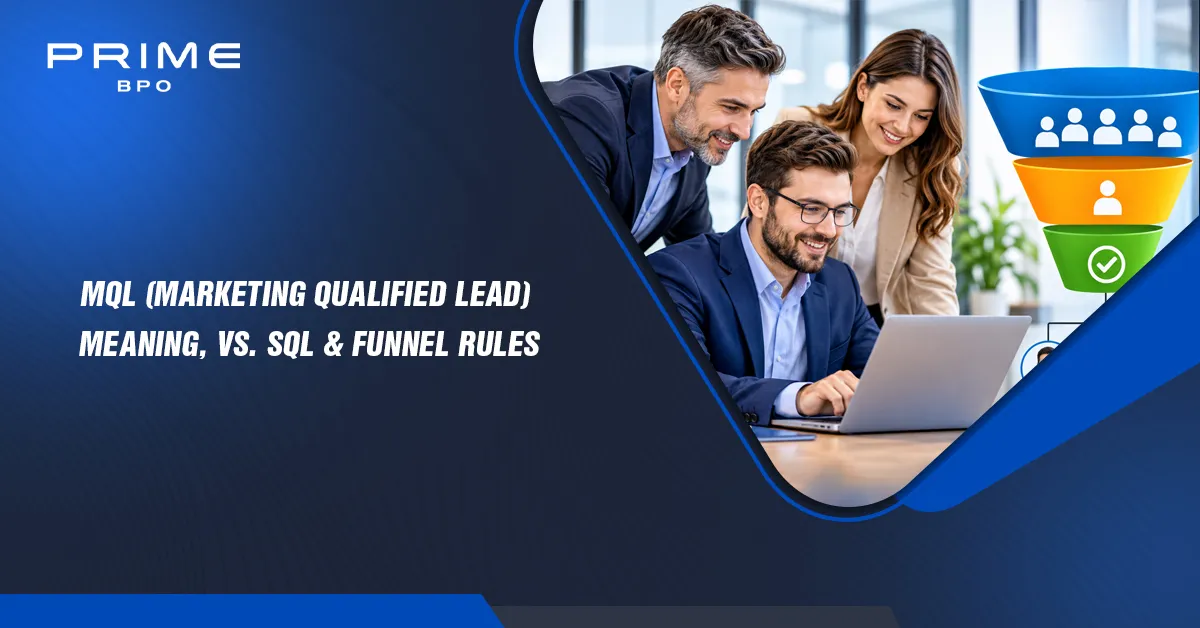





































An MQL (marketing qualified lead) is a prospect who fits your ideal customer profile and has engaged with your marketing enough to be worth a sales conversation. The label matters because it's the point where marketing hands a lead to sales, and that handoff is where most B2B funnels leak.
Quick answer: An MQL is a lead that marketing has scored as a good fit and showing interest, based on firmographics and behavior like pricing page visits or demo requests. An SQL is a lead that sales has spoken with and confirmed has a real need, budget, authority, and timeline. Published agency data puts the typical B2B SaaS MQL to SQL conversion rate at about 13%.
What Is an MQL (Marketing Qualified Lead)?
A marketing qualified lead is a contact that meets two tests: they look like a buyer on paper, and they've acted like one. The first test is fit, such as company size, industry, and job title. The second is engagement, such as downloading a buying guide, attending a webinar, or visiting the pricing page more than once. When a lead passes both, marketing flags it as an MQL and routes it to sales.
MQL meaning and definition
MQL stands for marketing qualified lead. The term comes from B2B demand management, where marketing and sales agree on stage definitions so both teams count the same things. The SiriusDecisions Demand Waterfall, first published in 2006 and now maintained by Forrester, made stages like MQL and SAL standard vocabulary in B2B marketing.
In practice, MQLs mean different things at different companies, which is why the definition has to be written down. A useful MQL definition answers three questions:
- Who counts? The firmographic and role criteria a lead must meet.
- What behavior counts? The actions that signal buying interest, and how much each is worth.
- What happens next? Who receives the MQL, and how quickly they must act on it.
What does MQL mean for marketing
For marketing teams, MQLs are often the main output metric, and sometimes the main target. That's useful because it ties campaigns to something sales can act on. It's also risky: if marketing is judged on MQL volume alone, it's easy to lower the bar and pass along leads sales will ignore. The healthiest teams track MQL volume and MQL to SQL conversion together, so quality and quantity are measured in the same report. Our guide to lead generation marketing covers how those campaigns feed the funnel.
MQL vs. SQL at a glance
The difference between a marketing-qualified lead (MQL) and a sales-qualified lead (SQL) is who did the qualifying and how. Marketing qualifies an MQL from data and behavior, without talking to the person. Sales qualifies an SQL in a conversation, confirming need, authority, budget, and timing.
MQL = fits the ideal customer profile + shows buying interest (scored by marketing)
SQL = MQL + confirmed need, authority, budget, timing (verified by sales)
Note: An MQL is a prediction. An SQL is a confirmation. Treating MQLs as if they were already confirmed opportunities is the most common cause of friction between marketing and sales.
Lead vs. MQL vs. SAL vs. SQL vs. PQL
Most B2B funnels move a contact through four stages: lead, MQL, SAL, and SQL. Companies with a free trial or freemium product add a fifth, the PQL, which can skip the marketing stages entirely. Each stage has an owner and an exit rule, and the funnel only works when both teams agree on them.
Lead
A lead is any contact who has given you their details or engaged in a way you can track: a newsletter signup, a content download, a trade show badge scan, or a list you've built through research. Leads haven't been scored yet. Many will never be a fit, and that's normal at the top of the funnel.
MQL (marketing qualified lead)
An MQL is a lead that has crossed your scoring threshold. It matches your ideal customer profile (ICP) and has shown enough engagement to suggest interest. MQL leads are owned by marketing until they're routed to sales.
SAL (sales accepted lead)
A sales accepted lead is an MQL that a sales development rep has reviewed and agreed to work. The SAL meaning in business is simple: sales has said "yes, this is worth a call" and taken ownership. The SAL stage exists so that rejected leads don't silently disappear. If a rep rejects an MQL, they record why, and marketing uses those reasons to tune scoring.
SQL (sales qualified lead)
A sales qualified lead is a prospect sales has spoken with and confirmed as a real buying opportunity. Qualification usually follows a framework:
- BANT: Budget, Authority, Need, and Timeline. Simple and quick, and common for SDR qualification calls.
- MEDDPICC: Metrics, Economic buyer, Decision criteria, Decision process, Paper process, Identify pain, Champion, and Competition. It grew out of the MEDDIC framework developed at Parametric Technology Corp in the 1990s and is used mainly for complex, high-value deals.
The SQL meaning in sales and in marketing is the same: this lead is ready for a formal sales conversation, such as a discovery meeting or demo with an account executive.
PQL (product qualified lead)
A product qualified lead is a user who has reached a meaningful level of product usage, such as inviting teammates, connecting an integration, or hitting a plan limit, during a free trial or on a free plan. PQLs are common in product-led growth companies. Because the person has already experienced the product's value, PQLs often convert at higher rates than MQLs, though there's no reliable public benchmark that holds across products.
|
Stage |
What it means |
Key criteria |
Owner |
Moves forward when |
|
Lead |
A contact you can track |
Any engagement or contact data |
Marketing |
They meet fit criteria and score enough to qualify |
|
MQL |
A scored, likely buyer |
ICP fit plus behavioral score above threshold |
Marketing |
Routed to and accepted by sales |
|
SAL |
A lead sales agreed to work |
Rep review within the SLA window |
SDR or BDR |
Discovery call confirms the opportunity |
|
SQL |
A confirmed buying opportunity |
BANT or MEDDPICC criteria met |
SDR, then account executive |
A meeting or opportunity is created |
|
PQL |
A user showing buying signals in the product |
Usage milestones in a trial or free plan |
Growth or sales team |
Sales reaches out or the user upgrades |
Lead -> MQL -> SAL -> SQL -> Opportunity -> Closed won
^
PQL (product usage) ------------+ (often routed straight to sales)

MQL vs. SQL vs. PQL: How the Stages Differ
The stages differ in what evidence they rely on. MQLs rest on marketing data, SQLs on a sales conversation, and PQLs on product usage. Knowing which evidence you're looking at tells you how much weight to give a lead and what to do next.
MQL vs. SQL
MQL vs. SQL comes down to interest versus readiness. An MQL shows that someone is researching a problem you solve. An SQL shows that they have a defined need, someone with authority to buy, a budget, and a reason to act soon. Marketing generates MQLs at scale, while SQLs require a person to qualify each one, which is why SDR capacity is often the real constraint on pipeline.
A quick way to tell them apart: an MQL might be a director who downloaded three guides on call center outsourcing this month. That same person becomes an SQL after a call where they confirm they're replacing a vendor next quarter, own the decision with their CFO, and have budget approved.

MQL vs. PQL
MQL vs. PQL is content engagement versus product engagement. An MQL read about your product; a PQL used it. PQLs are stronger signals, but they only exist when you offer a self-serve trial or free plan. Many software companies run both: MQLs for buyers who want a demo first, and PQLs for those who try before they talk.
PQL vs. SQL
PQL vs. SQL is self-serve versus sales-assisted. A PQL shows value has been experienced, but it doesn't confirm who will sign the contract or how much they'll spend. Sales still qualifies a PQL into an SQL when the deal needs a larger plan, procurement review, or security approval.
Sales accepted lead vs. sales qualified lead
The difference between an SAL and an SQL is review versus conversation. An SAL means a rep has looked at the lead and agreed it deserves outreach. An SQL means the rep has talked with the prospect and confirmed the opportunity. Many leads are accepted but never become SQLs because the person doesn't respond or turns out not to be buying.
Building a marketing-to-sales handoff SLA
A service level agreement turns the handoff from a hope into a process. It should set out, in writing:
- Shared definitions: The exact criteria for MQL, SAL, and SQL, agreed by both teams.
- Response time: How fast sales must accept or reject a new MQL and make the first contact attempt.
- Follow-up cadence: The number of attempts and channels before a lead can be closed out.
- Rejection reasons: A short pick list, such as wrong contact, no budget, student or competitor, so marketing can learn from them.
- Recycling rules: When unready leads go back to marketing nurture instead of being deleted.
- Shared reporting: One dashboard showing volume and conversion at every stage.
Speed deserves special attention. A widely cited Harvard Business Review study by Oldroyd, McElheran, and Elkington found that companies that contacted online leads within an hour were nearly seven times as likely to qualify them as companies that waited even an hour longer, and more than 60 times as likely as those that waited 24 hours or more.
|
Dimension |
MQL |
SQL |
PQL |
|
Evidence |
Firmographics and content behavior |
A qualification conversation |
Product usage |
|
Qualified by |
Marketing automation and scoring |
SDR, BDR, or account executive |
Product data, then sales |
|
Typical signals |
Pricing page visits, webinars, guide downloads |
Confirmed need, authority, budget, timeline |
Feature adoption, invites, usage limits |
|
Main risk |
High volume, low intent |
Slow qualification limits volume |
Users who never intend to pay |
|
Best for |
Sales-led B2B with content programs |
Complex or high-value deals |
Product-led software with trials |
Get Free Quotes
Customized Options Await
MQL to SQL Conversion Rate: Formulas, Benchmarks and Fixes
Your MQL to SQL conversion rate is the share of MQLs that sales confirms as qualified opportunities. It's the single best measure of whether marketing and sales agree on what a good lead looks like. Published agency data puts most industries between 10% and 26%, with B2B SaaS at 13%.
How to calculate MQL to SQL conversion
Use the same group of leads from start to finish, a cohort, rather than dividing this month's SQLs by this month's MQLs. Leads take weeks to move between stages, so mixing months distorts the rate.
MQL to SQL rate = SQLs from the cohort / MQLs in the cohort x 100
SQL to opportunity rate = Opportunities created / SQLs x 100
Opportunity to win rate = Closed-won deals / Opportunities x 100
MQL to customer rate = Closed-won deals / MQLs x 100
Here's a hypothetical quarter for a B2B services company:
MQLs generated: 800
Accepted as SALs: 560 (70% acceptance)
Became SQLs: 104 (13% of MQLs)
Opportunities: 62 (60% of SQLs)
Closed won: 16 (26% of opportunities)
MQL to customer: 2%
The example shows why each stage matters. Lifting MQL to SQL from 13% to 16% would add 24 SQLs, and at the same downstream rates about 4 more customers, without generating a single extra MQL.

MQL to SQL conversion rate benchmarks
First Page Sage, a marketing agency, publishes MQL to SQL conversion rates from its client data gathered between 2019 and 2025. These are vendor-reported figures from one agency's clients, so treat them as a rough reference rather than an industry standard.
|
Industry |
MQL to SQL conversion rate |
|
B2B SaaS |
13% |
|
IT and managed services |
13% |
|
Financial services |
13% |
|
Healthcare |
13% |
|
Software development |
14% |
|
Cybersecurity |
15% |
|
Manufacturing |
16% |
|
Staffing and recruiting |
12% |
|
Legal services |
10% |
|
Business insurance |
26% |
Two cautions apply. First, your definition of SQL changes the number: First Page Sage counts an SQL only once a meeting with a salesperson is booked, and a stricter definition produces a lower rate. Second, a very high rate can be a warning sign. If 40% of your MQLs become SQLs, your MQL bar may be so high that marketing is filtering out leads sales could have won.
Building an intent-based lead scoring model
A lead scoring model adds up two kinds of points: explicit fit, which is who the lead is, and implicit behavior, which is what they've done. Requiring a minimum fit score stops a highly active student or competitor from becoming an MQL. The point values below are a hypothetical starting model to adjust with your own data.
|
Signal |
Type |
Example points |
|
Company size within your ICP range |
Fit |
+15 |
|
Target industry |
Fit |
+10 |
|
Director, VP, or owner title |
Fit |
+15 |
|
Pricing page visit |
Behavior |
+10 each, up to 20 |
|
Demo or contact request |
Behavior |
+30 |
|
Webinar attendance |
Behavior |
+10 |
|
Case study or buying guide download |
Behavior |
+5 |
|
Personal email domain or student |
Negative |
-15 |
|
Competitor domain |
Negative |
-50 |
|
Careers page only |
Negative |
-10 |
|
No activity for 30 days |
Decay |
-10 |
In this hypothetical model, the MQL threshold could be a total score of 60, with at least 25 of those points from fit. Direct hand-raises like demo requests can bypass scoring and go straight to sales.

How to improve MQL to SQL conversion rate
Low conversion usually traces back to one of a handful of causes. Diagnose before you fix.
|
Symptom |
Likely cause |
Fix |
|
Reps reject many MQLs as poor fit |
Scoring overweights content downloads |
Raise the fit minimum; add negative scoring |
|
Good leads go cold before contact |
Slow response, no SLA |
Set and enforce a response time; route instantly |
|
Many SALs never reach a conversation |
Too few follow-up attempts |
Use a multi-touch cadence by phone and email |
|
SQLs stall before an opportunity |
Weak qualification on the first call |
Train SDRs on BANT and discovery questions |
|
Marketing and sales report different numbers |
No shared definitions |
Write stage definitions into the CRM and SLA |
|
Rejected leads disappear |
No recycling process |
Send unready leads back to nurture with a reason code |
Of these, response speed is often the fastest win, given the Harvard Business Review findings on how quickly lead quality drops after the first hour. If your team can't cover every inbound lead quickly, that's a capacity problem, not a marketing problem. For outbound programs, our guide to outbound call center lead generation covers how calling teams fit into the funnel.
Get Free Quotes
Customized Options Await
How to Scale Lead Qualification With Prime BPO
When MQL volume grows faster than your SDR team, leads wait, and waiting leads go cold. Outsourcing the first stage of qualification, the calls that turn MQLs into SALs and SQLs, adds capacity without a long hiring cycle. The steps below work whether you keep qualification in-house or bring in a partner.
Step 1: Audit your scoring and handoff
Pull the last two quarters of MQLs and trace each one through the funnel. Look for three numbers: how long MQLs waited before first contact, what share sales accepted, and the most common rejection reasons. That tells you whether the problem is lead quality, speed, or follow-up.
Step 2: Write qualification rules a caller can follow
Turn your SQL definition into a short call guide. List the BANT questions that matter for your offer, the answers that qualify or disqualify, and what to do with "not now" leads. Clear rules let any trained caller, in-house or outsourced, qualify leads the same way.
Step 3: Close the response-time gap
If inbound MQLs sit for hours because reps are busy with meetings, consider a dedicated team whose only job is first contact and qualification. Prime BPO's lead generation services cover outreach by phone, email, and social media, qualification based on interest, budget, and decision-making power, appointment setting for qualified leads, and keeping lead details organized in your CRM.
Step 4: Pilot, measure, and scale
Start with one segment or lead source so you can compare results against your in-house baseline:
- Share your ICP and SQL criteria. Agree on definitions, call guides, and disqualification rules.
- Connect the CRM. Give the team access to log every attempt, outcome, and rejection reason.
- Set the SLA. Agree on first-contact time, attempts per lead, and the handoff format for booked meetings.
- Run a 30 to 60 day pilot. Track contact rate, SAL acceptance, MQL to SQL conversion, and meetings held.
- Review weekly. Feed rejection reasons back to marketing to tighten scoring.
- Scale what works. Expand to more segments once conversion holds steady.
Prime BPO operates from six offices in Rawalpindi, Pakistan, and holds ISO 18295-1:2017 certification for customer contact services. Its lead generation page lists technology and SaaS, financial and insurance services, healthcare, and ecommerce among the industries it supports. If you're weighing roles, our guides to what an SDR does in sales and SDR vs. BDR explain how each fits into the funnel.
Note: Calling US business leads still has rules. The FTC's 2024 Telemarketing Sales Rule amendments extended the ban on misrepresentations to business-to-business calls and added recordkeeping requirements, and FCC rules under the TCPA require consent for autodialed or prerecorded calls to wireless numbers, including business cell phones. Make sure any calling team, in-house or outsourced, follows them.
Conclusion
An MQL is marketing's best prediction of a future buyer, and an SQL is sales' confirmation. The gap between the two is where pipeline is won or lost: unclear definitions, weak scoring, and slow follow-up all show up as a low MQL to SQL conversion rate. Agree on stage definitions, score for fit as well as activity, enforce a response-time SLA, and measure conversion by cohort. Then decide whether your team has the capacity to follow up on every qualified lead quickly.
|
Your situation |
Where to start |
|
Sales says MQLs are poor quality |
Add a fit minimum and negative scoring |
|
MQLs wait hours or days for contact |
Set a response-time SLA and add qualification capacity |
|
Marketing and sales report different numbers |
Write shared stage definitions into the CRM |
|
Many leads accepted but few become SQLs |
Improve call cadence and BANT training |
|
You have a free trial or free plan |
Track PQLs alongside MQLs |
|
Conversion is fine but volume is too low |
Invest in demand generation, then scale qualification |
Scale Your Lead Qualification With Prime BPO
If your MQLs are waiting too long for a first call, scale your lead qualification with Prime BPO. Prime BPO's team can handle outreach, qualification calls, and appointment setting so your account executives spend their time on qualified opportunities.
- Explore the service: Prime BPO lead generation services
- Business development support: Prime BPO business development
- Request a pipeline review: Contact Prime BPO
- Call: +92-51-8733177
Frequently Asked Questions
What is a MQL marketing qualified lead?
A marketing qualified lead (MQL) is a prospect who fits your ideal customer profile and has engaged with your marketing enough to suggest buying interest, such as visiting the pricing page, attending a webinar, or requesting information. Marketing identifies MQLs through lead scoring and passes them to sales for follow-up, where they become sales accepted leads and, if confirmed, sales qualified leads.
What does MQL mean for marketing?
For marketing, MQL is the stage where its work becomes something sales can act on. MQL volume shows how much interest campaigns are creating, and MQL to SQL conversion shows whether that interest is the right kind. Marketing teams that track both, rather than volume alone, tend to have better alignment with sales and more predictable pipeline.
What is the difference between a marketing-qualified lead (MQL) and a sales-qualified lead (SQL)?
An MQL is qualified by marketing from data and behavior, without a conversation. An SQL is qualified by sales after speaking with the prospect and confirming they have a real need, the authority to buy, a budget, and a timeline. An MQL shows interest; an SQL shows readiness for a formal sales conversation such as a demo or proposal.
What is a qualified lead?
A qualified lead is a prospect who meets your criteria for being a likely customer. Qualification happens in stages: marketing qualifies leads on fit and engagement to create MQLs, sales accepts them as SALs, and sales then confirms buying readiness to create SQLs. What counts as qualified depends on the definitions your marketing and sales teams agree on and write down.
What is a good MQL to SQL conversion rate?
There's no single standard, but First Page Sage's agency data puts most industries between 10% and 26%, with B2B SaaS, IT services, financial services, and healthcare at about 13%. Compare against your own history first. A rising rate over several quarters matters more than matching a benchmark, and a rate far above 30% can mean your MQL bar is set too high.
Sources and 2026 Verification
All figures and definitions were checked against the sources below in November 2026.
- First Page Sage: MQL to SQL conversion rate by industry: vendor-reported conversion rates from client data, 2019 to 2025
- Forrester: The Demand Waterfall, what sales operations needs to know: history of the SiriusDecisions Demand Waterfall (2006, 2012, 2017 versions)
- Harvard Business Review: The Short Life of Online Sales Leads: lead response time research by Oldroyd, McElheran, and Elkington
- HubSpot: MEDDPICC methodology: MEDDPICC definitions and MEDDIC origin at PTC
- Prime BPO: lead generation services: service scope, industries, and ISO 18295-1:2017 certification
- Federal Register: Telemarketing Sales Rule amendments (April 16, 2024): business-to-business misrepresentation ban and recordkeeping rules
- eCFR: 47 CFR 64.1200: TCPA rules on autodialed and prerecorded calls
This article is for general information and isn't legal advice. Benchmarks vary by company, definitions, and data source, so use them as a reference alongside your own funnel data. Lead scoring point values and funnel figures marked hypothetical are illustrations, not industry standards.