


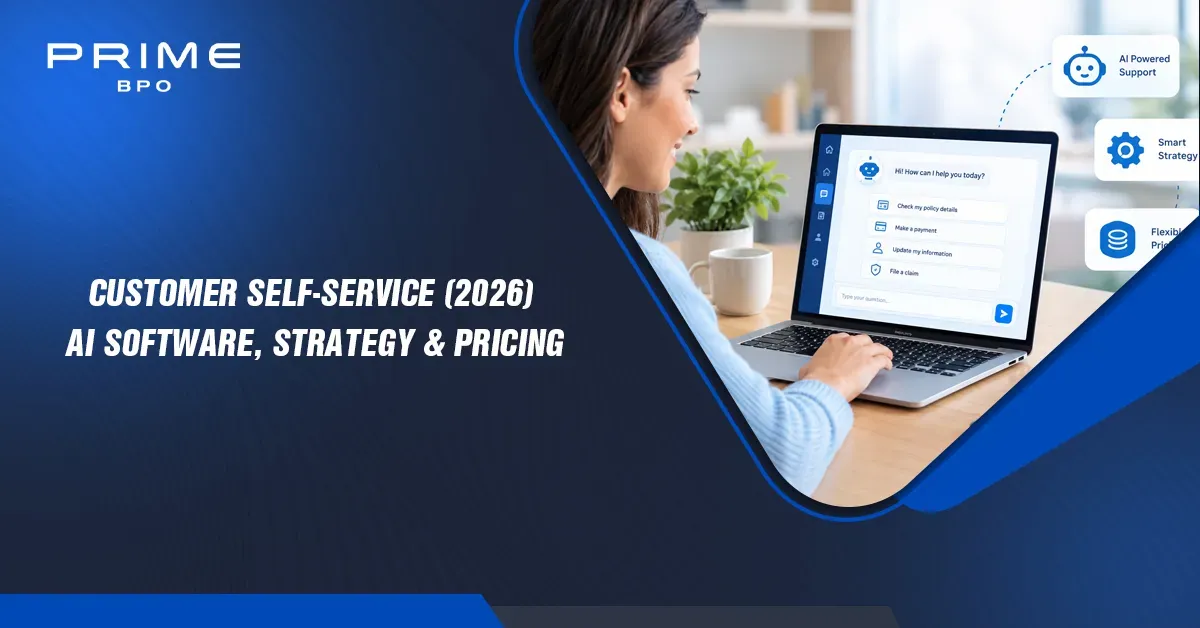
Gartner puts the average cost of a live contact by phone, chat, or email at $8.01, compared with about $0.10 for a contact handled on a company website or app. The same research firm also found that only 14% of customer service issues are fully resolved in self-service. Both numbers matter. This guide explains what customer self-service is, the five channel types, what the leading self-service platforms cost in 2026, and how to design a strategy that cuts contact volume without trapping customers in a bot loop.
Quick answer: Customer self-service is the set of tools, including knowledge bases, account portals, AI agents, in-app guides, and communities, that let customers solve problems without contacting an agent. It works best as a hybrid: self-service handles simple, repetitive requests 24/7, and a one-click handoff sends everything else to a trained human team with full context.
What is customer self-service?
Customer self-service is any support channel that lets customers find answers, manage accounts, or complete tasks on their own, at any time, without waiting for an agent. Common examples are help centers, order-tracking and billing portals, AI chat agents, interactive voice response (IVR) menus, and user communities. The goal is to resolve the request, not just avoid a ticket.
The modern self-service ecosystem
A working self-service system is a chain of layers, not a single tool. Each layer feeds the next, and the last one is always a human:
- Knowledge base (KB): the single source of truth. Articles, FAQs, how-to videos, and policies that both customers and AI agents draw from.
- Authenticated customer portal: where logged-in users check orders, pay bills, start returns, update details, and see ticket status.
- Conversational and agentic AI: an AI agent that answers questions from the KB and, increasingly, takes actions such as issuing a refund or rescheduling a delivery through connected systems.
- Contextual in-app guidance: tooltips and walkthroughs inside the product, at the moment of need.
- Live agent escalation: a handoff to a human, through chat, email, or phone, that carries the full conversation and customer data so the customer never repeats themselves.
If any layer is weak, the whole system fails. Gartner's 2024 survey found that when self-service fails, it's usually because customers couldn't find relevant content (43% of cases) or felt the company didn't understand what they were trying to do (45%). Both are knowledge and design problems, not technology problems.
Note: IVR is the original self-service channel. Modern IVR uses natural language instead of keypad menus, but the same rule applies: make it easy to reach a person. See Prime BPO's guide to interactive voice response systems.
Core benefits of customer self-service
The main benefits of customer self-service are lower cost per contact, instant 24/7 answers, and capacity that scales without hiring at the same rate. Done well, it also improves agent retention, because humans spend less time on password resets and order-status questions. Those benefits only show up when self-service actually resolves the issue.
Economic impact: cost per contact
Gartner's benchmark is the most cited figure: live channels (phone, chat, email) average $8.01 per contact, while self-service on a company website or app costs about $0.10 per contact. AI agents sit in between, because vendors now charge per conversation or per resolution:
|
Contact type |
Typical cost per contact |
Basis |
|
Website or app self-service (KB, portal) |
About $0.10 |
Gartner |
|
AI agent conversation or resolution |
About 0.49–2.00 |
2026 list prices: Freshdesk, HubSpot, Intercom Fin, Zendesk, Agentforce |
|
Live agent (phone, chat, email) |
About $8.01 |
Gartner |
Illustrative example: a company receives 10,000 contacts a month. If an AI agent fully resolves 30% of them at $1.00 each instead of $8.01 for a live contact, the savings are 3,000 × $7.01 = $21,030 a month, before software seat costs. The math falls apart if "deflected" customers simply call back, which is why resolution rate matters more than deflection rate.

Operational speed: 24/7 with no hold times
Self-service answers instantly at 2 a.m. and on public holidays. For simple, high-volume requests such as tracking an order, resetting a password, downloading an invoice, or changing an address, many customers would rather click than wait. That's how self-service lifts customer satisfaction (CSAT) and first contact resolution (FCR): the fastest resolution is the one with no queue.
Scalability and agent burnout
Self-service absorbs seasonal spikes and growth without proportional hiring. It also removes the most repetitive work from human queues, which matters because repetitive, high-volume work is a major driver of agent stress and attrition. Agents can then focus on complex cases, upset customers, and high-value accounts. Learn more about why call center jobs are so stressful.
Note: Self-service is not free. Software, AI usage fees, knowledge base upkeep, and integration work all cost money. Measure cost per resolved contact, not cost per contact handled.
Get Free Quotes
Customized Options Await
Types of customer self-service channels and examples
There are five main types of customer self-service: account portals, knowledge bases, conversational and agentic AI, in-app guidance, and peer communities. Most businesses need the first two before anything else, since AI agents and communities are only as good as the knowledge underneath them.
1. Customer self-service portals and dashboards
A customer self-service portal is a logged-in area where customers manage their own accounts. Examples include checking order status, starting a return or exchange, paying an invoice, updating a card, changing a subscription plan, and viewing open tickets. Because it's authenticated, a portal can show personalized information that a public FAQ can't.
2. Interactive knowledge bases and search
A knowledge base is a searchable library of articles, FAQs, videos, and troubleshooting guides. The best ones use predictive search, clear titles written in customer language, and step-by-step visuals. Tools such as Document360 and Stonly add interactive, branching guides that walk customers through decisions.
3. Conversational and agentic AI
Generative AI agents, such as Intercom Fin, Zendesk AI agents, Salesforce Agentforce, Freddy AI Agent, and HubSpot's Customer Agent, answer questions in natural language from your knowledge base. Agentic AI goes a step further: it calls connected systems to complete tasks, such as checking an order in your e-commerce platform and issuing a refund within policy limits.
4. Embedded in-app guidance and walkthroughs
In-app guidance appears inside your software: onboarding checklists, tooltips, and step-by-step walkthroughs, from tools such as Whatfix and Pendo. It prevents tickets before they're created, which makes it especially useful for SaaS products.
5. Peer-to-peer community forums
Communities let customers answer each other's questions, from developer forums to user groups. Platforms include Discourse and Khoros. They work well for technical products with engaged users, but need moderation and a staff presence to stay accurate.

Customer self-service channel matrix
|
Channel type |
Key capabilities |
Best use cases |
Example tools |
|
Self-service portal |
Login, account actions, order and billing history, returns |
E-commerce, telecom, utilities, insurance, subscriptions |
Zendesk, Salesforce Experience Cloud, HubSpot customer portal |
|
Knowledge base |
Articles, search, videos, interactive guides |
Every business; the foundation for AI |
Document360, Stonly, Zendesk Guide, Freshdesk |
|
Conversational / agentic AI |
Natural-language answers, task execution, handoff |
High-volume repetitive questions, 24/7 coverage |
Intercom Fin, Zendesk AI, Agentforce, Freddy AI, YourGPT |
|
In-app guidance |
Tooltips, walkthroughs, checklists |
SaaS onboarding, feature adoption |
Whatfix, Pendo |
|
Community |
Forums, Q&A, user groups |
Technical products, developer platforms |
Discourse, Khoros |
|
Voice self-service (IVR) |
Menus or natural-language voice, account lookups |
Phone-heavy industries, payments, status checks |
Contact center platforms |
For more on channel design, see Prime BPO's guide to multichannel vs. omnichannel support.
Top customer self-service software and pricing (2026 comparison)
The best customer self-service software depends on your size and stack. Zendesk and Freshdesk are the easiest all-round help desks, Intercom Fin leads on AI resolution, Salesforce Agentforce suits companies already on Salesforce, and HubSpot Service Hub fits HubSpot CRM users. In 2026, almost every vendor combines per-agent seats with a usage fee for AI.
How customer self-service software pricing works
- Per-agent subscriptions: a monthly fee for each human agent seat, which usually includes the help center, portal, and ticketing.
- Resolution-based AI fees: you pay only when the AI fully resolves a conversation. Intercom Fin and Zendesk's automated resolutions use this model.
- Conversation or session-based AI fees: you pay for each AI conversation, resolved or not. Agentforce, Freddy AI Agent, and HubSpot's Customer Agent use variants of this model.
- Credit pools: prepaid credits consumed by AI actions, such as Salesforce Flex Credits and HubSpot Credits.
- Onboarding fees and minimums: some higher tiers add one-time setup fees or seat minimums.

Top customer self-service platforms compared
|
Platform |
Core advantage |
Key self-service features |
Best for |
Estimated 2026 pricing |
|
Zendesk Suite |
Mature, all-in-one help desk |
Help center, portal, AI agents, community |
SMB to enterprise |
55–115/agent/month (Team–Professional, annual); automated resolutions 1.50–2.00 each beyond included amount |
|
Intercom (Fin AI) |
High-performing AI agent |
Fin AI agent, help center, messenger |
SaaS and digital-first companies |
29–132/seat/month (annual); Fin from $0.99 per resolution |
|
Salesforce Service Cloud + Agentforce |
Deep CRM data and agentic actions |
Agentforce agents, Experience Cloud portals |
Enterprises on Salesforce |
Agentforce for Service add-on $125/user/month; 2perconversationorFlexCredits(500 per 100,000) |
|
Freshdesk |
Value pricing |
Knowledge base, portal, Freddy AI Agent |
SMB and mid-market |
19–89/agent/month (annual); extra Freddy AI Agent sessions about $0.49 each |
|
HubSpot Service Hub |
Native to HubSpot CRM |
Knowledge base, customer portal, Customer Agent |
HubSpot users, SMB |
Starter about $20/seat/month; Professional $90/seat/month plus $1,500 onboarding; AI about $0.50 per conversation in credits |
|
Stonly |
Interactive step-by-step guides |
Guided flows, KB, agent scripts |
Complex troubleshooting |
Quote-based |
|
Document360 |
Dedicated knowledge base |
KB authoring, versioning, AI search |
Documentation-heavy teams |
Quote-based tiers |
|
Udesk |
Omnichannel help desk |
Ticketing, chatbot, call center |
Teams needing voice and chat together |
Quote-based |
Prices are list prices from third-party pricing reviews checked between July and October 2026 (see Sources). Vendors change plans often, so confirm on the official pricing page before buying.
Note: Model the AI fee at your real volume. For example, 3,000 AI resolutions a month costs about $2,970 on Fin at $0.99 each, or 4,500–6,000 on Zendesk's overage rates, on top of seat costs. For more on tools, see Prime BPO's AI customer service guide.
Building a winning customer self-service strategy: trends and best practices
A good customer self-service strategy starts with your contact data, not with a tool. Find the 10 to 20 reasons customers contact you most, build answers and automated workflows for the simple ones, and keep a fast, context-rich path to a human for everything else. Then measure resolution, not deflection.
Trend 1: Agentic AI and autonomous task execution
AI agents are moving from answering questions to completing tasks: processing a return, rebooking an appointment, or updating an address by calling your systems' APIs. This raises the ceiling on automation, but it also raises the stakes. Set clear guardrails such as refund limits, identity checks, and audit logs, and route exceptions to a human.
Trend 2: Hyper-personalized authenticated portals
Portals increasingly show each customer their own data: orders, usage, open tickets, and next-best actions, with the AI agent working inside that logged-in context. A personalized answer ("Your order shipped yesterday and arrives Friday") resolves far more than a generic article on shipping times.
Best practice 1: The one-click escalation rule
Never trap a customer in a bot loop. Every self-service screen and AI conversation should offer a visible "talk to a person" option, and the handoff must pass the full transcript, customer ID, and the steps already tried. Trigger escalation automatically on repeated failed answers, negative sentiment, high-value accounts, or sensitive topics such as billing disputes and cancellations.
Best practice 2: Audit the knowledge base continuously from ticket data
Gartner found that 43% of self-service failures happen because customers can't find relevant content. Close that gap every month:
- Export the top contact reasons from tickets, chat logs, and call dispositions.
- Compare them with search terms that returned no results and articles with low helpfulness ratings.
- Write or rewrite articles in the customer's language, with screenshots or short video.
- Retire outdated content, because the AI agent will repeat it.
- Have frontline agents flag gaps, since they hear the questions first.

Best practice 3: Mobile-first design
Many customers will start on a phone. Use short articles, large tap targets, fast search, and portal actions that work on a small screen. Test every top task on mobile before launch.
KPIs to track
|
KPI |
What it measures |
How to use it |
|
Self-service resolution rate |
Share of issues fully resolved without an agent |
The headline metric; check that customers don't call back |
|
Ticket deflection rate |
Share of visitors who view help content and don't open a ticket |
Useful, but can hide unresolved issues |
|
First contact resolution (FCR) |
Issues resolved in the first interaction, in any channel |
Should rise as escalations carry context |
|
CSAT |
Satisfaction after self-service or AI conversations |
Compare with live-agent CSAT |
|
Cost per resolved contact |
Total cost divided by resolved contacts |
The true ROI measure |
|
Escalation rate and reasons |
How often and why customers reach a human |
Shows where to improve the KB and AI |
Prime BPO's guides to CSAT and call center metrics explain how to measure each one.




































The hybrid support model: AI self-service with Prime BPO human teams
Self-service handles volume; people handle everything self-service can't. The strongest support operations run both as one system: AI and portals resolve simple requests instantly, and a trained human team picks up escalations with full context, around the clock.
Why 100% automated self-service fails without a human fallback
- Most issues still aren't fully resolved in self-service. Gartner's 2024 survey put the figure at 14% overall and 36% even for issues customers called "very simple."
- Complex and emotional issues need judgment. Billing disputes, bereavement, fraud, and outages call for empathy and discretion.
- Both loops damage loyalty. Customers who can't reach a person often abandon or churn, and the cost doesn't show up in deflection metrics.
- AI needs supervision. Someone has to review conversations, correct wrong answers, and update the knowledge base.
How Prime BPO supports a hybrid model
Prime BPO provides the human side of a hybrid customer self-service operation:
- Escalation handling: trained agents for phone, email, live chat, and social media take over when self-service can't resolve the issue.
- 24/7 coverage: support across time zones, so escalations don't wait until the next business day.
- Knowledge base and content upkeep: agents who handle tickets every day are well placed to flag gaps and draft new articles from real customer questions.
- Quality assurance: call and chat monitoring, plus reporting on CSAT, FCR, and handle time.
- Certified processes: Prime BPO holds ISO 18295-1:2017 certification for customer contact services.
Read more on customer support outsourcing, help desk outsourcing, and AI, automation, and the human touch.
Conclusion:
Customer self-service is now the first stop for most support journeys, and AI agents have made it far more capable. But the winners aren't the companies that automate the most. They're the ones that resolve the most: strong knowledge, personalized portals, AI with guardrails, and a fast handoff to skilled people.
|
Your situation |
Where to start |
|
High volume of "where is my order" or billing questions |
Authenticated portal plus an AI agent connected to order and billing data |
|
Customers can't find answers in your help center |
Knowledge base audit based on ticket data |
|
SaaS product with onboarding tickets |
In-app guidance plus knowledge base |
|
Already on Salesforce or HubSpot |
Native AI agent (Agentforce or HubSpot Customer Agent) |
|
Small team, tight budget |
Freshdesk or Zendesk Team plan with a focused KB |
|
Bot loops and falling CSAT |
One-click escalation to a trained human team |
|
Need 24/7 coverage without building a night shift |
Hybrid AI self-service plus an outsourced support team |
Scale your support team with Prime BPO
If you're rolling out customer self-service, the human layer behind it decides whether customers stay happy. Prime BPO customer support solutions combine trained, ISO 18295-1-certified support agents with your self-service and AI tools, covering phone, email, chat, and social media 24/7.
Contact Prime BPO or call +92-51-8733177 to discuss your support volumes, escalation flows, and staffing needs, and see how Prime BPO can help optimize your customer experience.
Get Free Quotes
Customized Options Await
Frequently asked questions
What is self-service customer service?
Self-service customer service lets customers solve problems on their own, without contacting an agent, using a knowledge base, an account portal, an AI chat agent, an IVR, or a community forum. It's available 24/7 and typically costs a fraction of a live contact, about $0.10 for web self-service compared with $8.01 for a live contact, according to Gartner.
What are the 7 qualities of good customer service?
Commonly cited qualities are responsiveness, empathy, clear communication, product knowledge, consistency, ownership (following through until resolved), and accessibility (being easy to reach in the customer's preferred channel). In self-service, these show up as fast answers, plain language, accurate content, and an easy route to a person. See Prime BPO's 7 pillars of customer service.
What are examples of self-service?
Common examples include an online help center, an order-tracking page, a returns portal, password reset links, an AI chatbot that answers account questions, a voice IVR that reads your balance, in-app product walkthroughs, and community forums where users answer each other.
What is 24/7 customer service?
24/7 customer service means support is available 24 hours a day, 7 days a week, including nights, weekends, and holidays. Most companies combine always-on self-service and AI agents with a human team working in shifts or across time zones, often through an outsourced provider, so complex issues are handled at any hour.
What are the 7 principles of customer service?
There's no single official list, but common versions include: put the customer first, listen actively, respond quickly, be honest and transparent, resolve on first contact where possible, personalize the interaction, and follow up. Prime BPO's golden rules of customer service covers these in more depth.
What are the 10 main types of customers?
A common framework groups customers as: new, loyal, impulsive, discount-driven, need-based, wandering (browsing), potential (prospects), angry or dissatisfied, insistent (demanding), and indecisive. For self-service, the useful point is that loyal and need-based customers often prefer to help themselves, while angry and indecisive customers usually need a person quickly.
What is a good self-service resolution rate?
There's no universal benchmark, and it depends heavily on how simple your contact mix is. Gartner's survey found that customers fully resolved only 14% of issues in self-service overall. Track your own baseline, then aim to raise it month over month while CSAT holds steady.
Sources And 2026 Verification
- Gartner: Only 14% of customer service issues are fully resolved in self-service (opened Oct 15, 2026)
- Gartner: Only 9% of customers report solving issues completely via self-service; live contact $8.01 vs. self-service $0.10 (Sept 25, 2019) (opened Oct 15, 2026)
- DragApp: Zendesk pricing 2026 (updated Oct 7, 2026)
- DragApp: Intercom pricing 2026 (updated Sept 11, 2026)
- DragApp: Freshdesk pricing 2026(updated Aug 15, 2026)
- Salesforce Break: Agentforce pricing tiers explained (Jul 17, 2026)
- HelpYap: HubSpot Service Hub pricing (Jul 21, 2026)
- Prime BPO: Customer services Prime BPO: Customer services (opened Oct 15, 2026)
Note: Software prices are list prices reported by third-party reviews and change often; confirm with each vendor. Cost-per-contact figures are Gartner averages; the $21,030 savings example is an illustration based on stated assumptions, not a benchmark.