






























Your best agent just resolved a customer issue in four minutes flat. The call scores show 95% satisfaction. Sounds perfect, right?
But here is the problem, you are measuring effort, not the impact. The customer churned three months later. Your team hit all the numbers, but you are retention tanked.
This is what happens when you track the whole wrong call center metrics . Most BPO teams focus on speed and volume while ignoring the numbers that actually drive profit.
What Are Call Center Metrics & Why They Matter
Also matrics at the indicators that show how well your team is performing against the business goals. They're not members, they determine whether you keep the customers, hit revenue targets and scale without turning out your staff.
The problem is not lack of data. Modern contact centers generate thousands of data points daily. The problem is tracking the wrong ones. A study by COPC Inc. found that 60% of call centers measure activity metrics but only 35% accurately track the outcome metrics .
Think this way, you can have a 99% answer rate but a 40% customer retention rate. Which one is better for your business? The metrics you choose determine which problems you will actually solve.
The 10 Essential Call Center Metrics You Should Track
Your team should focus on three categories that are operational efficiency, customer experience and business outcome metrics . Here are the ones that actually matter.

Operational Metrics
- The average handle time, total call time including after call work. Industry average is 6 to 8 minutes.
- First call resolution, percentage of calls that are resolved without callback. The target is 75%
- Abandonment rate, calls hung up before reaching an agent. The target is below 5%
Customer Experience Metrics
- Customer satisfaction score, post call surveys rating. The target is 85%
- Net promoter score, likelihood to recommend. Target is 50+
- Customer effort score, how easy was it to resolve? The target is 8/10 or higher.
Business Outcome Metrics
- Customer lifetime value, total revenue from a customer relationship
- Churn rate, percentage of customers lost monthly. The target is below 3%
- Revenue per contact, direct revenue impact of interactions
- Agent productivity, revenue that is generated by an agent hourly .
The difference between "call centers" and great ones? The great ones obsessed over FCR and NPS while optimising AHD. The bad ones try to minimize ADHD at any cost, destroying the customer experience in the process.
Get Free Quotes
Customized Options Await
Real-World Benchmarks — What Does "Good" Look Like?
Generic advice is useless. Where is what actual performance looks like across the industries?
Benchmark Comparison Table 1: Industry Standards by Sector
|
Metric |
Financial Services |
Retail |
Healthcare |
Tech SuBPO rt |
|
AHT |
8-10 min |
5-6 min |
10-12 min |
12-15 min |
|
FCR |
75-80% |
65-70% |
70-75% |
60-65% |
|
CSAT |
82-86% |
80-84% |
80-85% |
78-82% |
|
Abandonment |
2-4% |
4-6% |
3-5% |
5-8% |
|
NPS |
45-55 |
35-45 |
40-50 |
40-50 |
The data source from COPC Inc. And HDI call center benchmarks 2024.
If you are in financial services and your FCR is 60%, that's the red flag. You are 15 to 20% below industry standards. Each 1 percent improvement in FCR typically saves $50,000-$150,000 annually through repeated contacts.
The Metrics-to-Revenue Connection: Where the Money Actually Is
Here is what most BPO leaders miss, not all metrics are created equal.
A 1 percent improvement in AHD might save $5000 monthly. A1 improvement in FCR typically generates $50,000-$80,000 in value to reduce repeat contacts, improve their attention and higher the customer lifetime value.
Yet most teams fixate on AHT because it is easy to measure and reward. This creates a perverse incentive, the agent/the customers of the phone to hit time targets, resulting in the poor resolution and angry callbacks.
The Real Revenue Impact Table:
|
Metric Improvement |
Monthly Call Volume (10,000) |
Annual Financial Impact |
|
AHT: 6 min → 5 min |
10% productivity gain |
$40,000-$60,000 |
|
FCR: 70% → 75% |
500 fewer repeats |
$80,000-$120,000 |
|
CSAT: 80% → 85% |
2-3% retention lift |
$150,000-$300,000 |
|
NPS: 40 → 50 |
Customer advocacy growth |
$200,000-$500,000 |
Common Call Center Metrics Mistakes - And How to Avoid Them
- Measuring activity instead of outcomes
- Not segmenting the metric by team or issue type
- Setting targets based on what is easy to achieve, not what's profitable
- Ignoring the relationship between metrics
- Not tracking the customer efforts
How to Actually Improve Your Call Center Metrics
Knowing what to measure is step one. Improving it is step two.
For FCR improvement
- Invested knowledge management system. Agent with instant access to solution resolve the issues 30% faster
- Implement the transfer reduction programs. Every transfer drops FCR by 15 to 20%
- Train on route cause diagnosis, not just the surface level fixes
- Track and reduce knowledge gaps monthly
For CSAT improvement
- Postal service should appear within 60 seconds the response rate drops 40% after that
- Focus on agent empathy and effort not just knowledgeability
- Handle difficult customers with managers 10 to 15 percent of the time. This rebuild the relationship
For AHT optimization (without destroying quality)
- Reduce non-work time through better systems and tools
- Avoid back-to-back calls. 2 30 minute break part shift improved quality and reduces fatigue
- Use AI assisted routing to match the complex calls with experience agents
For reducing abandonment
- Monitor queue time in real time and it is adjusting the staffing dynamically
- Implement callback options instead of making customers wait
- Most abandonment happens in the first 30 seconds of time, improving the weight experience.

Technology and Tools That Enable Better Call Center Metrics Tracking
Modern analytics transformed raw data into actionable insights. The right tools make a massive difference.
Look for the real-time dashboard, automatic alert systems, predictive analytics and integration with your CRM so you can connect calls to outcomes.
AI powered quality management tools now analyse hundred percent of calls instead of sampling 3 to 5%. This reveals a pattern human supervisors miss and it catches the problems immediately instead of weeks later.
CLOSING - Final Thoughts
Call center metrics are not about surveillance or micromanagement. They are all about understanding what is working, what is broken and where your team needs suBPO rt to succeed.
The teams that win are not the ones measuring more. They are the ones measuring smarter focusing on FCR, CSAT and NPS, collecting those metrics real word outcomes and using the data to coach rather than punish.
If you are managing a call center and suspect your metrics might not be telling the full story, it is worth a conversation with your operation teams. Are you making outcomes that actually drive revenue? Are your agents empowered to resolve issues on the first contact, or you are optimising for speed at the low cost of quality?
The cab between where you are and where you could be often comes down to metrics focus. Fix that with Prime BPO and everything else gets easier.
Get Free Quotes
Customized Options Await
FAQS
What are call center metrics?
Call center metrics at numbers that you have your customer service team are doing their job. Think of them like grades on the report card. Just like a teacher tracks if you are issued up to the class, turning in homework and passing the test, call center tracks if agents are answering calls fast, solving the problems and you can make customers happy.
What are the 4 metrics of customer service?
The four most important customer service metrics are speed, solving the problems on first contact, customer happiness and the cost.
What are the 5 key performance indicators of a call center?
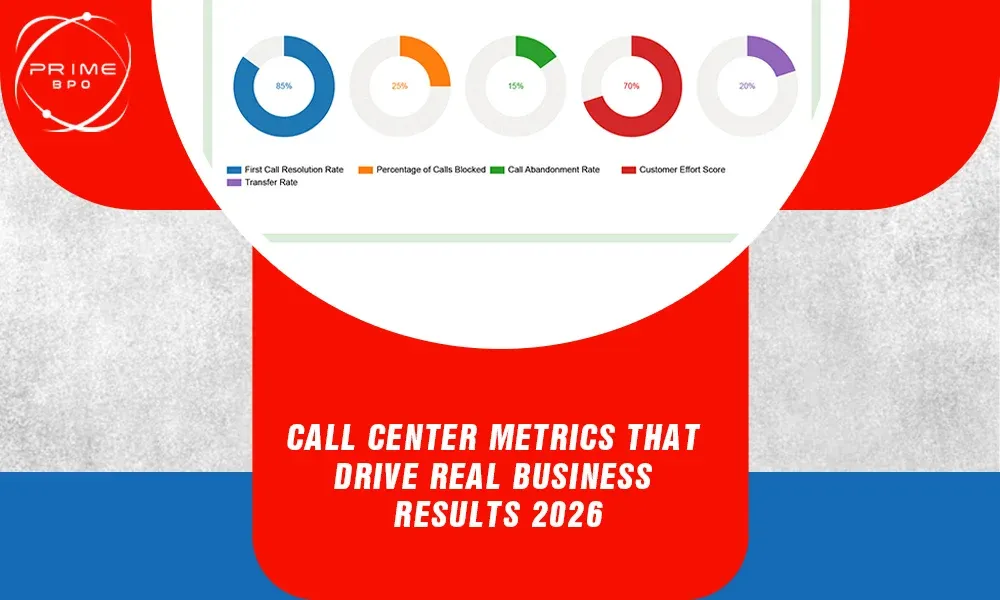
The five most important numbers to watch our first call resolution are FCR, customer satisfaction score CSAD, average handle time EHD, abandonment rate and customer effort score CES.
What are the 5 key performance metrics?
The five most important numbers any business tracks are productivity, how much work is each person doing, and quality is the work good? Does it meet standards?, Efficiency like is worth getting done without wasting time or money, customer satisfaction are your customers are happy? And also the cost, how much money it takes to get the job done.