





















A new hire just take a call about a billing dispute. They freeze, put the customer on hold for three times and then the customer hangs up and cancels.
This is not something that is in the hiring problem. This is a call center training problem and it happens in the centers that skip the structure for speed.
Rest on boarding is a single big region that first year agents underperform and it is completely available with the right program.
What Is Call Center Training, Exactly?
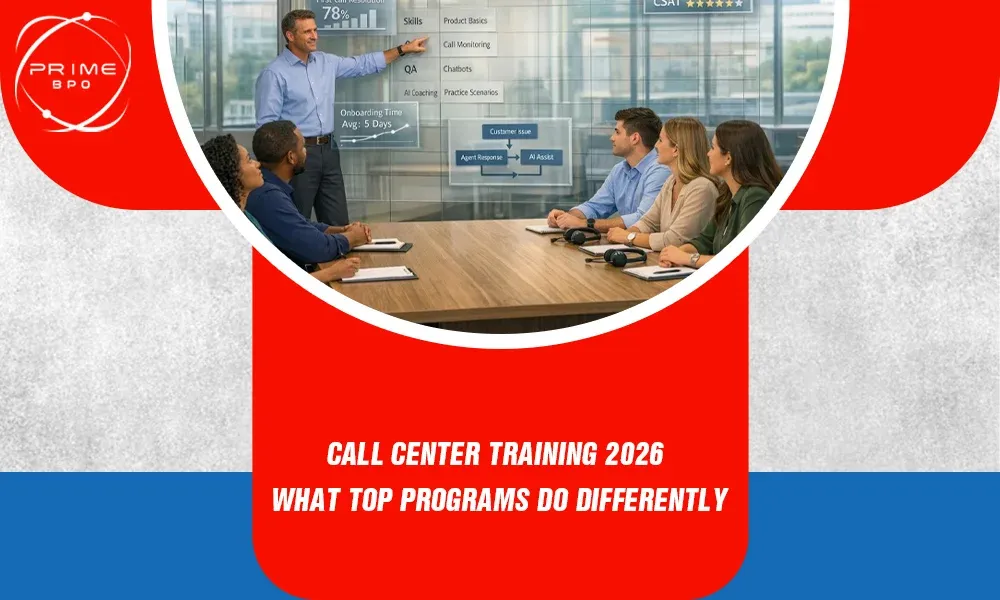
Call center training is a structured cause of teaching the agents the system, script, compliance rules in the soft skills that they need to handle the independently and consistently.
It is not a one time event. A real program will cover on boarding, product knowledge, communication skills, quality assurance standards and ongoing coaching that will continue well past and agents first 90 days.
Centers that treat training as continuous rather than a one-off event see the payoff directly in performance. Consumers themselves back this up like a Calabrio report found that 70% believe call centers should invest more in agent training rather than adding more self-service channels, cited by MightyCall's 2026 training guide.

How Long Should Call Center Agent Training Take?
Most call center agent training programs run between two and six weeks before an agent takes live calls unsupervised, depending on complexity.
- Simple support (returns, order status): 1–2 weeks
- Technical or healthcare support: 4–6 weeks
- Financial services or insurance: 6–8 weeks, plus compliance certification
Even after go-live, agents typically need 60–90 more days of nesting and coaching before they hit full productivity. Cutting this timeline short to fill seats faster is the fastest way to inflate your error rate and your attrition numbers at the same time.

Types of Call Center Training Every Program Needs
A single onboarding class isn't enough. Here's what a complete call center training program actually covers.
- Product and systems training. Agents need hands-on time with your CRM, ticketing tool, and knowledge base before they touch a live call, not just a slide deck walkthrough.
- Call center customer service training. This covers tone, empathy, and resolution frameworks like acknowledge-apologize-act, so agents sound human instead of scripted.
- Call center sales training. For the outbound or Abal heavy teams, this will include the objection handling, needs recovering and crossing the techniques that are tied to real recordings.
- Call center soft skills training. Active listening, patience under pressure, and clear verbal communication and skills that separate a good agent from a great one.
- Call center empathy and de-escalation training. Role-played scripts for angry, frustrated, or vulnerable callers, with a clear escalation path when a call needs a supervisor.
- Call center quality assurance training. Agents review real (anonymized) call scores against your QA rubric so they understand exactly how they're evaluated.
- Call center leadership and management training. For team leads and supervisors such as coaching techniques, performance reviews, and how to run effective calibration sessions.
Get Free Quotes
Customized Options Await
Call Center Training Methods: Which One Actually Works?
There's no single best method and the best programs blend several, matched to the skill being taught.
|
Training Method |
Best For |
Retention Rate |
Typical Cost |
|
Classroom / instructor-led |
Compliance, product knowledge |
Moderate |
Low–Medium |
|
E-learning / call center virtual training |
Self-paced systems training |
Low–Moderate |
Low |
|
Call center simulation training software |
Live-call scenarios, objection handling |
High |
Medium–High |
|
Shadowing + reverse shadowing |
Real workflow exposure |
High |
Low |
|
Gamification |
Engagement, script memorization |
Moderate–High |
Low–Medium |
|
Ongoing micro-coaching |
Long-term skill retention |
High |
Low |
Simulation-based training consistently outperforms passive e-learning because agents practice decisions, not just information recall. This is also where AI is changing the game fastest.
AI-assisted coaching platforms now review 100% of calls instead of the small sample managers used to spot-check, which means agents get feedback on patterns they'd otherwise never see corrected, according to industry trend analysis from AlphaRun. This matters more in 2026 than it did even two years ago, since human agents still handle the vast majority of meaningful interactions and Gartner-cited data reported by Digital Minds BPO puts that figure at 90% of customer interactions still requiring skilled human agents despite advances in automation.
Call Center Training Ideas That Keep Agents Engaged
Structure matters, but engagement is what makes training actually stick. A few ideas that work across most teams:
- Call breakdown sessions. Play a real (anonymized) recorded call and have the group score it against the QA rubric before revealing the actual score. It builds judgment faster than a lecture.
- Peer role-play swaps. Pair agents up and have them alternate playing the customer and the agent on the toughest call types your team handles.
- Micro-learning between calls. Short 3–5 minute refreshers delivered during downtime beat a single long monthly session for retention.
- "Save the call" challenges. Present a half-finished, going-wrong call transcript and have trainees finish it in a way that recovers the customer.
- Accent and clarity coaching. For the global teams, the targeted call center training focused on the call center annunciation, not the excellent elimination and immediately improves the first wall resolution for the cross border support.
How to Build a Call Center Training Program: A Real Example
Here's how a mid-sized outsourced support team fixed a training gap in practice.
A 40-agent BPO team supporting an e-commerce client had a 90-day attrition rate near 40%. New hires were shadowing for two days, then going live.
The fix is that a structured four week program and one week of systems and product training, one week of scripted role play with QA scoring, one week of supervised live calls with the real time whisper coaching, and one week of the graduated independence with daily feedback.
Within two quarters, 90-day attrition dropped by roughly a third, and average handle time improved without hurting first-call resolution. Nothing about the product changed only the training structure did.

What Does Call Center Training Cost in 2026?
Budgeting for the training is very easy when you know where the money will actually go. The cost generally breakdown into four buckets like trainers salaries and time, learning management software or simulation licenses, loss productivity during the ramp period and materials or certification fees.
Financial services and healthcare programs run higher due to compliance certification requirements, while simple retail support programs sit at the lower end. The single biggest hidden cost isn't the training itself and it's re-training and turnover when the first program was too short or too generic to actually stick.
That hidden cost compounds fast. Every agent who leaves within the first 90 days takes their entire training investment with them, and the seat has to be filled and re-trained from zero. This is a major reason improving agent job satisfaction has such an outsized effect on the bottom line like better-supported agents boost efficiency and stay longer, which is exactly why call center managers surveyed for the Invoca State of the Contact Center report link job satisfaction gains directly to retention and CSAT improvements. Training isn't just a cost center when you look at it this way, it's the lever that protects every other investment you're making in the team.

Call Center Training Courses and Classes Worth Considering
If you're evaluating call center training courses rather than building a full internal program, look for options that include live call simulation, not just video modules. Certifications from recognized customer service bodies add credibility for agent resumes and management tracks, and blended programs that combine online call center training with live coaching sessions consistently outperform fully self-paced courses on retention.
Getting Your Training Program Right the First Time
A strong call center training program isn't about more hours in a classroom and it's about the right structure, at the right pace, with real coaching behind it.
If you're weighing whether to build this in-house or bring in a partner who already has the systems, QA frameworks, and simulation tools built and tested, that's exactly where Prime BPO can help. Our teams are trained on proven onboarding frameworks before they ever touch a live call, so you get consistent quality from day one instead of a long, costly ramp-up.
If you'd like to see how our training approach works for a team your size, we're happy to walk you through it such as no pressure, just a clear look at what's possible.
Get Free Quotes
Customized Options Await
FAQS
What training is needed for a call center?
The call center training usually covers communication skills, product knowledge, customer service, call handling, CRM software and problem-solving. The agent can also receive the training on script, quality standard and handling the difficult customers.
What is the 80/20 rule in call centers?
The 80/20 rule means that about 80% of the calls are must be answered within the first 20 seconds. The call into use this to identify the customers, issue or processes that have the biggest impact on the performance
What course is best for a call center?
There is no one best course for the call center but the course is in customer service, communication, sales, business administration or call center management can be very useful. For the new agents, the customer service and communication training are considered as the best starting points.
What skills are needed for a call centre?
The important skills include communication, active listening, patients, problem-solving strategy and time management.
And these are also required such as computer skills, and the ability to stay calm when handling difficult customers.