










































Introduction
Call center reporting plays a critical role in measuring performance, improving customer experience, and driving data-based decisions. Without accurate call center reports, managers struggle to understand agent productivity, service quality, and operational efficiency.
In this guide, you’ll learn everything about call center reporting, including report types, KPIs, dashboards, analytics, tools, templates, and best practices used by modern call centers. Whether you manage a small support team or an enterprise contact center, this article will help you turn raw data into actionable insights.
Get Free Quotes
Customized Options Await
What Is Reporting in a Call Center?
Reporting in a call center is the process of collecting, analyzing, and presenting data related to call center operations. This data is converted into structured call center reports that help managers track performance, identify issues, and improve efficiency.
Call center reporting typically covers:
- Call volumes and handling time
- Agent performance and adherence
- Customer satisfaction and quality scores
A call center reporting analyst usually manages this data, ensuring accuracy and relevance for decision-makers.
Types of Call Center Reports
There are three main types of call center reports, each serving a specific purpose.
Operational Call Center Reports
Operational reports focus on day-to-day activities and workload management.
Examples include:
- Call center daily report template
- Call center weekly report template
- Adherence report call center
These reports help supervisors manage staffing levels and agent availability.
Performance & Productivity Reports
Performance reports measure how effectively agents and teams are working.
Common examples:
- Call center agent performance report
- Call center productivity report sample
- Call center KPI report
These reports highlight strengths, weaknesses, and training needs.
Quality & Compliance Reports
Quality reports evaluate customer interactions and compliance with standards.
Examples include:
- Call center quality assurance report template
- Call center quality report format
- Call center calibration report
What are the three main types of reports?
Operational, performance/productivity, and quality/compliance reports.
Essential Call Center Reporting Metrics & KPIs
Call center reporting metrics help organizations measure success and efficiency.
Key Call Center KPIs
- Average Handle Time (AHT)
- First Call Resolution (FCR)
- Service Level
- Agent Adherence
- Customer Satisfaction (CSAT)
What are KPIs in a call center?
KPIs (Key Performance Indicators) are measurable values that show how well a call center meets business and service goals.
The 80/20 Rule in a Call Center
The 80/20 rule means 80% of calls should be answered within 20 seconds. It’s a common benchmark used in call center performance reports.
Call Center Reporting Dashboards & Real-Time Reporting
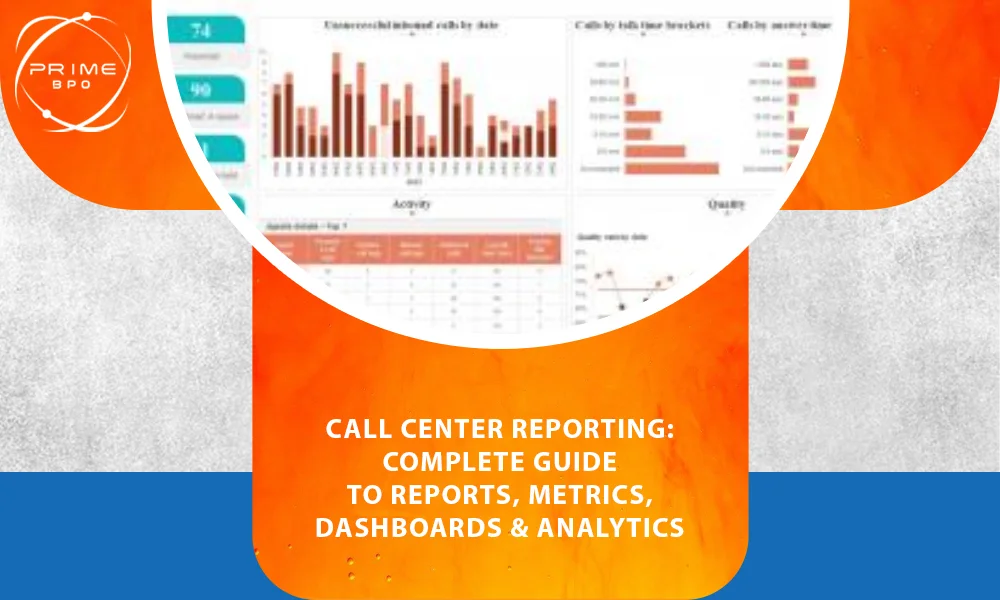
A call center reporting dashboard provides a visual overview of key metrics in real time. Unlike static reports, dashboards allow managers to respond immediately to performance changes.

Benefits of Real-Time Reporting
Instant visibility into call volumes
Instant visibility into call volumes means supervisors can see how many calls are coming in, how many are waiting in queue, and how many are being handled by agents at any given moment. This allows managers to react immediately to sudden spikes or drops in call traffic instead of discovering issues hours later through static reports.
Faster issue resolution
Faster issue resolution is achieved because real-time reporting highlights problems as they happen. For example, if wait times increase, call abandonment rises, or agent availability drops, managers can quickly take corrective action—such as reallocating agents, escalating issues, or adjusting call routing—before customer experience is affected.
Better workforce management
Better workforce management comes from having up-to-the-minute data on agent status, adherence, and workload. Real-time insights help supervisors balance staffing levels, reduce agent burnout, manage breaks effectively, and ensure service level targets are consistently met.
Because of these benefits, call center real-time reporting is essential for high-volume or customer-critical environments, where even a short delay can lead to long wait times, dissatisfied customers, lost revenue, or SLA breaches. Real-time visibility enables proactive decision-making rather than reactive problem-solving, ensuring smooth operations and consistent service quality.
Call Center Reporting Tools & Software
Modern call centers rely on advanced software for accurate reporting and analytics.
Popular Call Center Reporting Software
- Genesys call center reporting
- Avaya call center reporting
- Cisco call center reporting software
Advanced Reporting Platforms
Many call center platforms now offer:
- Automated trend detection and reporting
- AI-based call center analytics reporting
- Custom dashboards and exports
These tools eliminate manual reporting and improve accuracy.
Call Center Reporting Templates & Examples
Using templates ensures consistency and saves time.
Common Report Templates
- Call center report template
- Call center monthly report format
- Call center reports Excel templates
- Call center report examples
Templates are especially useful for call center management reports and executive summaries.
Call Center Analytics, Benchmarking & Industry Reports
Call center reporting and analytics go beyond basic metrics by identifying patterns and trends.
Analytics & Benchmarking
- Call center benchmarking report compares performance with industry standards
- Call center statistics report tracks long-term growth
- Call center industry report provides market insights
Analytics helps organizations predict demand and optimize resources.

Best Practices to Improve Call Center Reporting
To improve call center reporting, follow these best practices:
- Focus on actionable KPIs
- Automate recurring reports
- Use dashboards for real-time monitoring
- Customize reports for different roles
- Review reports regularly and act on insights
Effective reporting turns data into measurable improvements.
Call Center Reporting Roles & Responsibilities
A call center reporting analyst is responsible for:
- Collecting and validating data
- Creating reports and dashboards
- Analyzing trends and performance
Call center reporting analyst job description often includes strong analytical skills, Excel proficiency, and experience with reporting tools.
Conclusion
Call center reporting is essential for improving efficiency, agent performance, and customer satisfaction. By using the right reports, metrics, dashboards, and analytics tools, organizations can make smarter decisions and stay competitive.
Whether you rely on daily reports, real-time dashboards, or advanced analytics, strong call center reporting transforms raw data into meaningful business results.
Ready to turn real-time data into real results?
Discover how Prime BPO delivers powerful call center reporting and analytics to improve performance, visibility, and customer experience—contact Prime BPO today to get started.
Get Free Quotes
Customized Options Await
FAQs
What is reporting in a call center?
It is the process of analyzing call center data to measure performance and improve operations.
What are the three main types of reports?
Operational, performance, and quality reports.
What are KPIs in a call center?
KPIs are measurable indicators used to evaluate call center success.
What is the 80/20 rule in a call center?
It means answering 80% of calls within 20 seconds.