


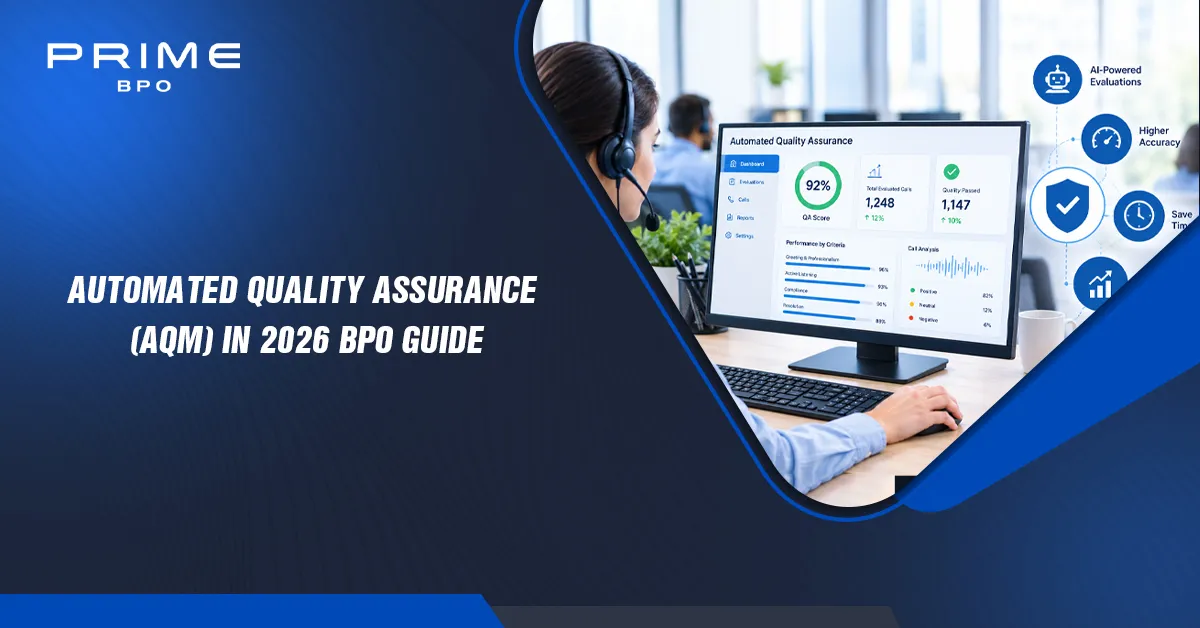
Most contact centers still judge agent quality by listening to a handful of calls. That leaves the vast majority of conversations unreviewed, including many of the ones where compliance slips or customers get frustrated. Automated quality assurance changes that by using speech and text analytics to score every interaction.
Quick answer: Automated quality assurance (also called automated quality management, or AQM) uses AI, including speech analytics, natural language processing, and generative AI, to evaluate up to 100% of customer interactions against a QA scorecard. Manual QA typically reviews only a small sample, often around 1% to 2%. AQM finds compliance risks and coaching needs faster, while human QA analysts review edge cases and lead coaching.
What is automated quality assurance (AQM)?
Automated quality management (AQM) is software that automatically evaluates contact center interactions, including calls, chats, emails, and messages, against your quality criteria. Instead of supervisors scoring a small random sample, AI transcribes and analyzes conversations at scale, scores them on a QA scorecard, and flags interactions that need human review or coaching.
What is AQM in practice?
- Capture: Calls are recorded and transcribed; digital interactions are collected.
- Analyze: Speech and interaction analytics detect topics, sentiment, silence, script adherence, and required disclosures.
- Score: Each interaction is graded against a scorecard, using rules, AI models, or generative AI.
- Act: The system surfaces low scores, compliance risks, and coaching opportunities to supervisors and agents.

The operational shift
|
|
Traditional QA |
Automated QA |
|
Approach |
Reactive auditing of a sample |
Proactive monitoring of nearly all interactions |
|
Focus |
Grading individual calls |
Finding patterns across teams and topics |
|
QA team role |
Listening and scoring |
Calibrating AI, reviewing exceptions, coaching |
Vendors say this approach can dramatically expand coverage. Verint, for example, reports a FinTech customer that increased quality and compliance coverage from 1% to 96% without adding headcount (a vendor-reported result).
See Prime BPO's guide to quality assurance in BPO.
Get Free Quotes
Customized Options Await
Manual QA vs. automated quality management
Manual QA relies on supervisors or analysts listening to a small sample of interactions, so most conversations are never reviewed, and feedback arrives days later. Automated quality management scores most or all interactions shortly after they happen, using consistent criteria, and directs human reviewers to the conversations that matter most.
The limits of manual call center quality assurance
- Tiny samples: Most teams can only review a small fraction of interactions; AmplifAI reports that many e-commerce contact centers evaluate less than 1%.
- Sampling bias: A few random calls per agent per month may not represent their real performance.
- Inconsistency: Different evaluators may score the same call differently.
- Slow feedback: Agents often hear about issues days or weeks later.
- Cost: QA analysts spend most of their time listening rather than coaching.
- Missed compliance risks: Breaches in unreviewed calls go undetected.
How AI and generative AI analyze 100% of interactions
AQM platforms transcribe every call, ingest digital conversations, and apply three types of evaluation:
- Rule-based checks: Detect specific phrases, such as a required disclosure or a forbidden statement.
- Machine learning models: Score sentiment, empathy, silence, interruptions, and talk ratio.
- Generative AI (LLM-based) evaluation: Read the whole conversation and answer scorecard questions in context, such as whether the agent resolved the issue or explained next steps clearly, and summarize the interaction.

Manual QA vs. AI-powered automated QA
|
Factor |
Manual QA |
AI-powered automated QA |
|
Sampling coverage |
Small sample, often 1%–2% or less |
Up to 100% of interactions |
|
Evaluation speed |
Days to weeks |
Minutes to hours after the interaction |
|
Cost per evaluated interaction |
High (analyst time) |
Low per interaction after setup |
|
Consistency |
Varies by evaluator |
Same criteria applied every time |
|
Compliance risk |
Many breaches go unseen |
Flags potential breaches across all interactions |
|
Agent feedback velocity |
Slow and infrequent |
Fast, with trends over many interactions |
|
Judgment on complex cases |
Strong |
Needs human review for edge cases |
|
CSAT impact |
Indirect, limited by sample size |
Finds root causes across all customers |
Note: AI scoring isn't perfect. Calibrate it against human reviewers regularly, and keep humans responsible for disputed scores, disciplinary decisions, and complex judgment calls.
Get Free Quotes
Customized Options Await
Core capabilities of real-time AQM software
AQM software combines speech and interaction analytics, automated call scoring, and compliance monitoring. Enterprise platforms like Verint and Calabrio package these into quality management suites, while some organizations build custom generative AI stacks on top of their own transcripts and scorecards.
Speech and interaction analytics
Speech analytics for call centers converts calls to text and analyzes what was said and how. Interaction analytics applies the same analysis to chat, email, and messaging. Typical signals include:
- Topics and reasons for contact
- Customer and agent sentiment
- Silence, hold time, and overtalk
- Keywords and phrases, such as cancellation intent or escalation requests
- Script and process adherence
Automated call scoring and QA scorecards
Automated call scoring applies your QA scorecard to each interaction. Simple items, such as "agent used the customer's name" or "agent read the required disclosure," can be scored by rules. Complex items, such as "agent showed empathy" or "agent resolved the root cause," are increasingly scored by AI models or generative AI. Most platforms let supervisors review and override AI scores.
Automated compliance monitoring
Automated compliance monitoring checks interactions for regulatory and policy requirements:
- PCI DSS: Detecting when payment card details are spoken, so recording can be paused or data redacted, because sensitive card security data must not be stored.
- HIPAA: Flagging improper handling of protected health information in healthcare support.
- TCPA and outbound rules: Checking that required consent and disclosure language is used on outbound calls.
- Internal policy: Detecting prohibited statements, missed verification steps, or unauthorized promises.
Real-time systems can alert supervisors during a live call, while post-call systems flag issues minutes later.
Calabrio vs. Verint vs. generative AI-native QA
After Thoma Bravo completed its acquisition of Verint in November 2025, it combined Verint with Calabrio. The merged company operates under the Verint name, and Calabrio's workforce engagement products keep the Calabrio name within the Verint CX Automation Platform.
|
Platform |
Core AI capabilities (vendor-stated) |
Real-time features |
Best operational fit |
|
Verint Quality Bot |
Autoscoring of up to 100% of voice and digital interactions; genAI-assisted form building; automated coaching assignment |
Real-time guidance offered through a separate Coaching Bot |
Large enterprises already using Verint workforce engagement tools |
|
Calabrio QM Intelligence |
Auto QA of up to 100% of interactions across human and AI agents; GenAI summaries; combined human and AI evaluations |
Trend and coaching insights; check current real-time options with the vendor |
Contact centers using Calabrio for workforce management and QM |
|
GenAI-native / custom LLM QA |
LLM-based scorecards on transcripts, custom prompts, summaries |
Depends on build |
Teams with data engineering resources and unique scorecards |
Note: Vendor claims, such as Calabrio's "99%+ AI accuracy in most instances," come from vendor marketing. Pilot any platform on your own interactions and compare AI scores with your best human evaluators before rolling it out.
See Prime BPO's guides to call center quality assurance software and call center analytics software.
Benefits of automated quality assurance
The main benefits of automated quality management are wider coverage, more consistent scoring, faster coaching, earlier detection of compliance risks, and lower QA cost per interaction. The result is better insight into what drives first call resolution, handle time, and customer satisfaction.
Reducing evaluator bias and standardizing criteria
When every interaction is scored against the same criteria, agents are judged on their full body of work instead of a few random calls. Consistent scoring also makes calibration sessions more productive, because QA teams review real patterns rather than debating one call.
Faster agent coaching and feedback
AQM can surface coaching opportunities within hours, and some platforms assign coaching automatically. Agent coaching and feedback become more specific: instead of "improve empathy," a supervisor can show an agent five recent calls where frustration rose after a hold.
Driving FCR, AHT, and CSAT
- First call resolution (FCR): Analytics reveal why customers call back, such as unclear explanations or missing steps, so teams can fix root causes.
- Average handling time (AHT): Analytics show where time goes, including holds, silence, and searching for information, without pressuring agents to rush.
- Customer satisfaction (CSAT) and NPS: Linking sentiment and survey results to interaction behavior shows which actions improve satisfaction.
Lowering QA cost
Automating listening and scoring lets QA analysts spend more time on coaching and calibration. Vendors report large savings: Verint cites a telecom customer that saved $4 million by increasing supervisor capacity through automated scoring of 1.8 million interactions, and Calabrio cites 50%–90% less time spent on manual quality work. Treat these as vendor-reported results; your savings depend on volume, channels, and current QA staffing.
|
Benefit |
What changes |
KPI impact |
|
Coverage |
Up to 100% of interactions reviewed |
Fewer blind spots |
|
Consistency |
Same criteria every time |
Fairer agent performance evaluation |
|
Speed |
Feedback in hours, not weeks |
Faster improvement |
|
Compliance |
Potential breaches flagged across all calls |
Lower regulatory risk |
|
Insight |
Root causes of repeat contacts |
Higher FCR and CSAT |
|
Cost |
Less manual listening |
Lower QA cost per interaction |
Get Free Quotes
Customized Options Await
Implementing AQM in contact center and BPO operations
Successful AQM rollouts start with a clear QA framework, a pilot that compares AI and human scores, and a human-in-the-loop model where QA leaders own calibration, disputes, and coaching. Technology alone doesn't improve quality; the process around it does.
The 7 pillars of quality assurance in contact centers
There's no single official list of "7 pillars of QA." A practical framework for contact centers:
|
Pillar |
What it covers |
|
1. Clear standards |
A documented QA scorecard tied to business goals |
|
2. Coverage |
Evaluating enough interactions, across all channels, to be representative |
|
3. Calibration |
Regular sessions so human and AI scores stay aligned |
|
4. Compliance |
Monitoring regulatory and policy requirements |
|
5. Coaching |
Turning findings into specific, timely feedback |
|
6. Customer outcomes |
Linking QA to CSAT, FCR, and complaints |
|
7. Continuous improvement |
Fixing processes, knowledge gaps, and tools, not just agents |






































Human-in-the-loop quality management
AI handles volume; humans handle judgment. In a human-in-the-loop model:
- AI scores all interactions and flags low scores, compliance alerts, and unusual patterns.
- QA analysts review a share of flagged and random interactions to validate the AI.
- Supervisors lead coaching, using AI-surfaced examples.
- Agents can dispute scores, with humans making the final call.
- QA leaders update the scorecard and retrain models as products and policies change.

Roadmap to automate quality control
- Audit your current QA program: scorecards, sample sizes, calibration, and coaching cadence.
- Define goals: compliance coverage, faster coaching, CSAT improvement, or cost reduction.
- Prepare data: recordings, transcripts, and digital interaction history, with privacy controls such as payment data redaction.
- Pilot: Run AI scoring alongside human scoring on one team or queue and measure agreement.
- Refine: Adjust scorecard questions, prompts, and thresholds where AI and humans disagree.
- Scale: Expand across queues, channels, and sites, including BPO partners.
- Govern: Set rules for score disputes, data retention, and model updates.
See Prime BPO's guides to improving the QA process in a call center, call center quality assurance best practices, and call center monitoring.
Conclusion:
Automated quality assurance turns QA from a small-sample audit into a view of nearly every customer interaction. Used well, it makes scoring fairer, coaching faster, and compliance monitoring broader. It works best when QA leaders stay in charge of calibration, disputes, and coaching.
|
Your challenge |
How AQM helps |
|
QA reviews only a few calls per agent |
Scores up to 100% of interactions |
|
Inconsistent scores between evaluators |
Applies the same criteria everywhere |
|
Slow agent feedback |
Surfaces coaching opportunities within hours |
|
Compliance risk in unreviewed calls |
Flags potential breaches across all interactions |
|
Unclear causes of repeat calls |
Reveals root causes behind low FCR |
|
Managing quality across BPO sites |
One scorecard and dashboard for every team |
Scale automated quality assurance with Prime BPO
Prime BPO runs offshore contact center operations from Pakistan for U.S. and international clients, with customer contact operations certified to ISO 18295-1:2017. Prime BPO contact center solutions include call quality assurance services, customer service, technical support, and inbound call center services, helping clients combine dedicated QA teams with modern quality monitoring tools.
Schedule an AQM audit at Prime BPO or call +92-51-8733177 to review your QA workflows and contact center KPIs.
Frequently asked questions
What does an automation QA do?
In a contact center, an automation QA specialist configures and manages automated quality management: building scorecards, setting rules and AI prompts, calibrating AI scores against human reviews, and turning results into coaching and process fixes. In software, an automation QA engineer writes scripts and tools that test applications automatically.
Is QA automation a good career?
It can be. In software, the U.S. Bureau of Labor Statistics reports a May 2025 median wage of $104,300 for software quality assurance analysts and testers, with 6% projected growth for the broader software developers, QA analysts, and testers group from 2025 to 2035. In contact centers, QA roles that combine coaching skills with analytics and AI tools are increasingly valuable, though pay varies widely by company and location.
What are the 7 pillars of QA?
There's no single official list. A practical contact center framework is: clear standards, coverage, calibration, compliance, coaching, customer outcomes, and continuous improvement.
Which AI is best for QA automation?
It depends on the job. For contact center quality management, enterprise platforms such as Verint Quality Bot and Calabrio QM Intelligence offer AI autoscoring of up to 100% of interactions, and some teams build custom large language model (LLM) evaluation on their own transcripts. The best choice fits your channels, existing systems, scorecards, and compliance needs; pilot before you commit.
Is QA a high paying job?
Software QA can be well paid: BLS reports a $104,300 median for software QA analysts and testers in May 2025. Contact center QA analyst roles typically pay less, with pay depending on industry, location, and seniority.
What is AQM in a call center?
AQM (automated quality management) is software that automatically scores call center and digital interactions against a QA scorecard using speech analytics and AI, so teams can evaluate far more interactions than with manual sampling.
Sources And 2026 Verification
Note: Sources opened October 22, 2026, except Prime BPO's contact page (October 20). Vendor performance and accuracy figures are vendor-reported and not independently verified.
Sources
- Verint: Quality Bot automated quality management
- Calabrio: QM Intelligence
- Thoma Bravo: Completes acquisition of Verint (Dec. 9, 2025)
- CXM World: Verint confirms single brand identity following Calabrio merger (Feb. 18, 2026)
- AmplifAI: Why e-commerce contact centers evaluate less than 1% of interactions (Apr. 10, 2026)
- U.S. Bureau of Labor Statistics: Software developers, QA analysts, and testers
- Prime BPO: Contact us (ISO 18295-1:2017 certification)