





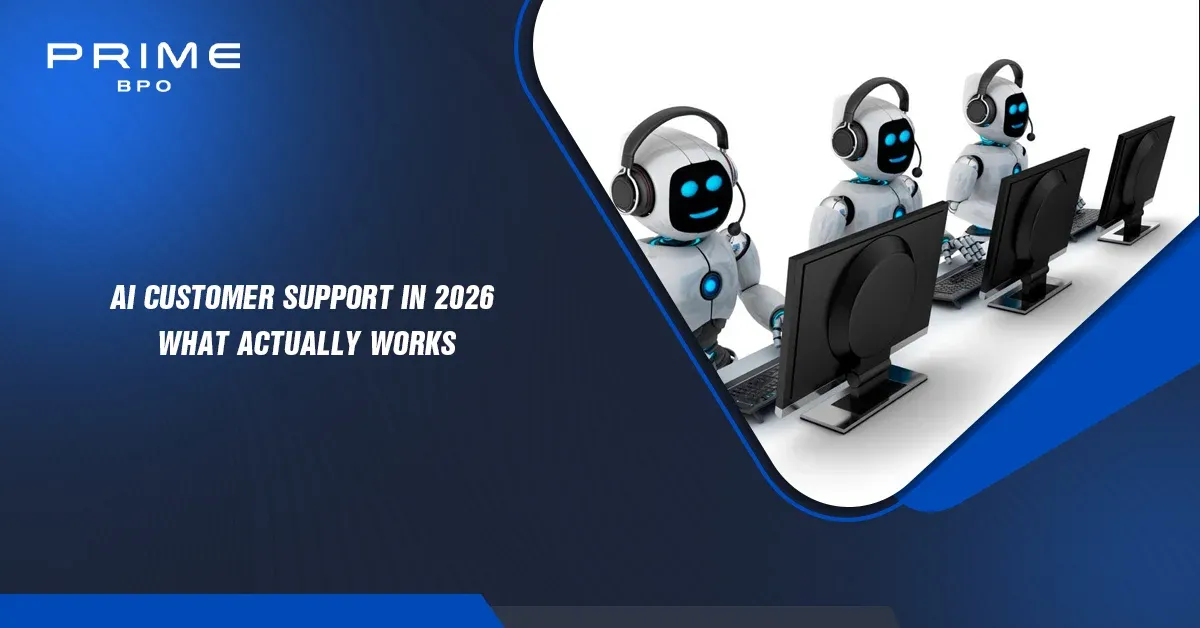
Most of the businesses that rush into AI customer support make the same mistake. They deploy a chatbot, expected to replace their team and then watch resolution quality drop while complaints about getting stuck with the bot pile up. The company is getting real value from AI customer support the opposite. They use AI to handle volume routine questions, kept the trained human in the loop for anything that is emotional or complex and measure result instead of assuming them.
This guide will explain what AI customer support actually does today, what are the costs, which tools are worth considering and how outsourced BPO providers fit into the picture. No inflated projections, no vague promises just what current data shows and how it applies.
Quick Answer
AI Customer support use his machine learning, natural language processing and generative AI to handle the customer inquiries through chatbots voice assistants, and autonomous AI agents. It works best for the repetitive, high volume task like order tracking, password reset and ticket routing.
What Is AI Customer Support and How Does It Actually Work?
AI customer support refers to the use of artificial intelligence including conversational AI, generative AI and machine learning to answer the questions, resolve the tickets and manage support workflow without requiring a human agent for every interaction. It covers everything from a simple rule based chatbots to a fully autonomous AI agent that can process a refund on its own.
The technology works in three layers. First, the natural language processing reads and interpret what the customer is asking, regardless of phrasing or typos. Second, the system matches that intent against the knowledge base, past tickets or accounts to find the correct answer. Third either the AI response directly or hands the case to a human agent with a full context attached.
This is different from older automation like static FAQ pages or basic IVR phone menu. Those systems follow fixed scripts. AI customer support is attached to the actual words a customer uses and can hold a multi turn conversation which is why adoption has moved so quickly across the contact centers. Grand view research estimated the global BPO market at $358.6 billion in 2026 with the same forecast projecting $695.8 in 2033, that is a 9.9% compound annual growth rate from 2026 (grandviewresearch.com) A meaningful share of that growth comes directly from AI powered call center and contact center automation replacing older, script-based systems.

Types of AI Customer Support Tools: Chatbots, Voice AI, and Autonomous Agents
Not all AI customer support software does the same job. Choosing the wrong category for your use case is one of the most common and expensive mistakes businesses make.
AI customer support chatbots handle text based conversations on your website, app or messaging channels. They are best for FAQ, auto status and simple account changes. AI customer support applies the same natural language understanding to phone calls, letting customers speak naturally instead of pressing numbers on the keypad. AI virtual assistants for customer support sit inside a product or app and proactively guide users, rather than waiting to be asked a question. AI agents for customer support a step further. These are generative AI systems that can take multi step actions on their own, such as looking up for an audit, applying a refund, and sending a confirmation email in a single interaction without even a human approaching each step.
Generative AI for customer support and headlines most of the modern tools in this list. Instead of matching a question to a pre-written script, generative AI draft and original, context aware response based on your knowledge base and a customers specific history. This is what allows today's AI customer support agents to sound less robotic then the chatbots five years ago.
|
AI Tool Type |
Primary Use Case |
Human Involvement Needed |
Common Examples |
|
Rule-based chatbot |
Simple FAQs, static answers |
High for anything outside script |
Legacy website widgets |
|
Conversational AI chatbot |
Natural language Q&A, order tracking |
Medium, for edge cases |
Zendesk AI, Intercom Fin |
|
Voice AI assistant |
Phone-based support, IVR replacement |
Medium, for escalations |
Google CCAI, Amazon Connect |
|
Autonomous AI agent |
Multi-step tasks, account actions |
Low, oversight only |
Salesforce Agentforce, Ada |






































Get Free Quotes
Customized Options Await
AI Customer Support vs Traditional Support vs BPO-Managed Support
The right choice usually is not "AI or humans." It is which combination fits your ticket volume, budget, and the complexity of what customers are asking. Here is how the three main models compare.
|
Factor |
Traditional In-House Support |
Pure AI Self-Service |
BPO-Managed AI + Human Support |
|
Availability |
Limited to shift hours unless staffed 24/7 |
24/7 by default |
24/7 with human backup |
|
Best for |
Complex, high-touch accounts |
High-volume, repetitive queries |
Mixed volume with quality requirements |
|
Setup cost |
Low, but ongoing hiring costs are high |
Moderate for platform and integration |
Moderate, often bundled into service fee |
|
Scalability |
Slow, tied to hiring cycles |
Instant |
Fast, providers can shift staffing quickly |
|
Risk of poor CX |
Low if well-staffed |
Higher if AI misreads intent |
Lower, human fallback catches AI errors |
This is also where outsourced customer support earns its place. A customer service outsourcing partner that has already integrated AI customer support tools into its call center services can scale coverage up or down faster than most internal teams, while still routing anything sensitive to a trained human agent.
Benefits of AI Customer Support for BPOs
AI customer support can make it easier for BPOs to handle a large number of customer requests. AI can take care of simple and repetitive questions, while human agents can focus on customers who need more help.
Lower Cost Per Interaction
AI can handle simple questions like order tracking, password resets, ticket routing, and basic account requests. This means agents do not have to spend their time on every small request, which can help lower the cost of each customer interaction.
24/7 Support
AI can answer customer questions at any time, even at night, on weekends, or outside normal working hours. This is especially useful for BPOs that support customers in different countries and time zones.
Faster Response and Resolution
Customers do not have to wait for an agent to become available for simple questions. AI can answer common questions right away and send more difficult issues to the right agent. This can help BPOs respond to customers faster and solve problems sooner.
Higher Agent Productivity
AI can take care of repetitive work, such as answering basic questions, sorting tickets, and summarizing customer conversations. This gives human agents more time to deal with difficult or sensitive issues that need personal attention.
Higher Agent Productivity
Customer requests can increase during holidays, sales, product launches, or service problems. AI can handle more simple requests during these busy periods without requiring a BPO to quickly hire and train many new agents. Human agents can then focus on more complex customer problems.

Best AI Customer Support Software and Platforms to Know in 2026
There is no single best AI customer support platform for every business. The right pick depends on your channel mix, existing CRM and whether you need voice, chat or both.
Among the best AI tools for the customer support currently invite use, a few categories stand out. Enterprise-grade platforms like Salesforce Agentforce and Zendesk's AI suite integrate directly with existing CRM and ticketing data, which means a strong choice for the companies that already run on those systems. Dedicated AI customer support chatbot platforms such as Intercom Fin and Ada focus specifically on conversational deflection and are often faster to deploy for mid-sized teams. For voice, platforms built on natural language voice AI, including Amazon Connect and Google's Contact Center AI, are the common choice for phone-heavy operations like insurance or telecom.
The AI for customer service market reflects how fast this space is moving.The AI for customer service market size was valued at USD 12.06 billion in 2024 and it is projected to reach USD 47.82 billion by 2030, at a CAGR of 25.8%. That kind of growth means new entrants and feature updates arrive constantly, so the safest approach is to pilot a tool on a limited ticket category before rolling it out across your full support operation.
Where AI Customer Support Saves Money, and Where Human Agents Still Win
AI customer support automation delivers its clearest returns in a few specific, repeatable tasks rather than across the board.
Automated ticketing and charting at AI and incoming request and send it directly to the right queue or specialist, cutting the time a ticket sits unassigned. Ticket classification and automatic ticket tagging will let support teams spot patterns across the thousands of tickets without manual review which will speed up root cause fixes for recurring issues. Deflection, where AI resolves a question before it ever reaches a human queue, works well for the password resets, order status and billing FAQs pulled from a well contained customer support base.
Where AI still falls short is anything involving frustration, ambiguity, or a decision with financial consequences for the customer. Gartner's own research backs this up directly.A Gartner poll of 163 customer service and support leaders conducted in March 2025 found 95% of customer service leaders plan to retain human agents to strategically define AI's role, an approach it describes as "digital first, but not digital only," avoiding the pitfalls of a hasty transition to an agentless model. (gartner.com) A separate 2026 Gartner survey found that customers themselves expect this balance.A Gartner survey of 3,566 B2B and B2C customers, conducted in February and March 2026, found that while 50% say their interactions are easier when companies use GenAI, 87% say it is essential for companies to provide an option to reach a human agent when using GenAI. (gartner.com) In other words, customers are open to AI, but they want an exit ramp to a person when they need one. gartnergartner
The adoption gap in contact centers reflects the same reality.88% of contact centers report using some form of AI, but only 25% have fully integrated automation into daily operations, and the difference between "using AI" and "deploying AI at scale" is where most organizations stall. (lorikeetcx.ai) Buying software is easy. Integrating it well enough that it actually improves resolution quality takes more work, and that is usually where outsourced partners with existing AI infrastructure have an advantage over a team building from scratch.

How to Choose the Right AI Customer Support Partner for Your Business
Before signing with any AI customer support service firm or BPO provider, run through the questions below. They separate providers who genuinely support omnichannel, hybrid delivery from those reselling a generic chatbot with a new logo.
Does the provider offer a real human fallback, not just a "contact us" dead end?
If a customer cannot reach a person within one or two attempts, both satisfaction and retention will suffer.
Can the AI customer support agent connect to your existing systems?
A tool that cannot read your order database or CRM will give generic, unhelpful answers no matter how advanced its language model is.
Does the provider report both efficiency and quality metrics?
Ask for resolution rate, re-open rate, and CSAT on AI-handled tickets specifically, not just how many tickets were deflected. A high deflection rate paired with a rising re-open rate usually means customers are getting bounced, not helped.
Is the pricing tied to outcomes or just seats and licenses?
BPO services that combine AI customer support automation with trained agents typically price based on ticket volume or resolution, which aligns their incentives with your actual results.
Can they scale coverage across time zones for true 24/7 customer support?
This matters most for businesses with a global customer base, where an AI customer support chatbot development service alone cannot cover every language and escalation nuance your customers need.
If you were thinking whether to build AI customer support in house or bring in a partner who already has a tool and the agency place, then Prime BPO walks you through what a hybrid setup would look like for your specific ticket volume and channels. There is no pressure, just a clear look at what would actually help.
Get Free Quotes
Customized Options Await
FAQS
What is the role of AI in BPO?
AI helps BPO companies to automate routine tasks, handle the customer questions, analyze their calls, manage data and support human agents.
Is there an AI CRM?
Yes, AI powered CRM systems can automate customer data entry, predict customer deeds, suggest responses and help the sales support teams work faster.
What is an AI customer support agent?
An AI customer support agent is a software that uses AI to answer the customer questions, solve their simple issues and complex problems to the human agents.
How is AI being used in customer service?
AI is used for chatbots, voice assistance, automated replies, call summaries, customer sentiments, ticket routing and 24/7 support.