






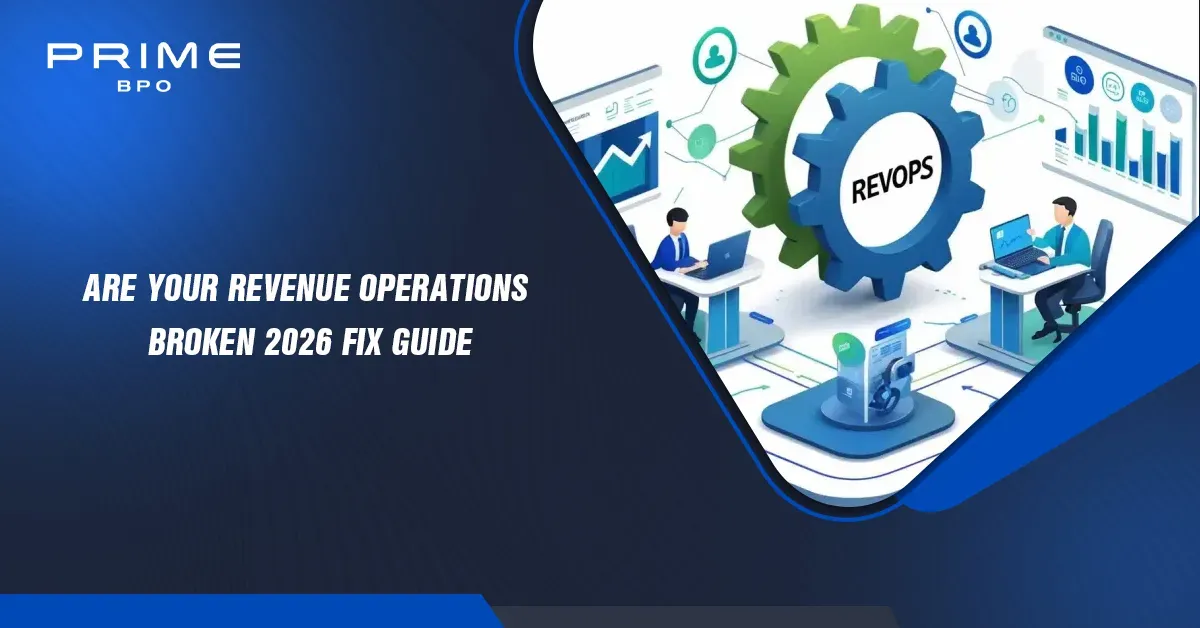





































Your forecast missed again. Marketing says that the leads were fine, the sales says that they were weak and customer success is quietly fighting churn that nobody planned for.
Most of the leaders are responding by buying another tool or hiring another rep.That is an expensive mistake. The real problem is usually that three teams run three separate processes on three sets of data, and revenue operations exist to fix exactly that.
What Is Revenue Operations?
Revenue operations is one function that runs the data, process it and technology behind seas, marketing and customer successful. So that they work towards a single revenue goal. That is the revenue operations understanding in simple terms. Instead of each team optimizing its own corner, there is a one group that owns the full customer journey from first click to renewal.
Gartner describes that it is an end to end model that unifies the customer engagement across the functions. It also expects 75% of the highest growth companies to adopt a RevOps model by 2026.
Adoption is already well underway. SyncGTM's 2026 RevOps Report, which draws on 1,200+ B2B companies, found that 78% now have a dedicated RevOps function, up from 48% in 2023. This is no longer an experiment.

Why Revenue Operations Matters Now
RevOps matters because the disconnected things quietly waste money, and the waste is miserable. Misaligned handoff, duplicate two and dirty data all drain the revenue growth before anyone notices it.
The payoff for fixing this is real. A Boston Consulting Group finding summarized by Qwilr reports that companies investing in RevOps see a 30% reduction in go-to-market costs and 10 to 20% gains in sales productivity.
Make sure to treat these numbers as directional benchmarks rather than the parent. Your results will depend on how messy you are starting point is.
Revenue Operations vs Sales Operations (and Marketing Ops)
Sales operations support the sales team only. Revenue operations supports the entire revenue cycle. That single difference decides which one you need.
|
Function |
Main focus |
Owns |
Typical blind spot |
|---|---|---|---|
|
Sales operations |
Closing deals efficiently |
Quotas, territories, CRM hygiene |
Ignores lead quality and churn |
|
Marketing operations |
Generating qualified demand |
Campaigns, scoring, attribution |
Cannot see post-sale revenue |
|
Customer success operations |
Retention and expansion |
Health scores, renewals |
Not tied to acquisition data |
|
Revenue operations |
Whole revenue cycle |
Shared data, process, tech stack |
Needs executive backing to work |
The Revenue Operations Framework: Four Pillars Plus One
A working revenue operations framework rests on five pillars: process, data, technology, people, and measurement. Skip one and the others wobble.
- Process: One defined path from lead to customer to renewal, with clear stage definitions and handoff rules. This is your revenue process, and everyone should be able to draw it from memory.
- Data: A single source of truth. SyncGTM's research shows that 31% of CRM admins say poor data quality costs their company at least 20% of annual revenue, according to figures compiled by Everstage.
- Technology: A lean stack that fits together. The same 2026 data shows teams averaging around 12 tools, and 67% of RevOps leaders plan to cut that number this year.
- People: Clear ownership, so nobody asks who is responsible for fixing a broken lead route.
- Measurement: Shared metrics across teams, such as pipeline velocity, net revenue retention (NRR), and customer acquisition cost.
Teams often start with tools. The stronger approach is to fix processes and data first, then choose technology that supports them.

Revenue Operations Strategy: What to Do in the First 90 Days
A good revenue operations strategy starts with an audit, not a purchase. Spend the first month learning where revenue actually leaks.
Days 1 to 30: Diagnose. Map the customer journey and list every handoff. Compare how each team defines a qualified lead, an opportunity, and a closed deal. Most companies find three different definitions.
Days 31 to 60: Standardize. Agree on one set of definitions. Clean the CRM and remove duplicate records. Set up one shared dashboard so everyone reads the same numbers.
Days 61 to 90: Automate and measure. Add revenue operations automation where it saves clear time, such as lead routing, data enrichment, and renewal alerts. Then track results against a baseline.

Get Free Quotes
Customized Options Await
Revenue Operations Tools, Software, and Platforms
You need a CRM, a marketing automation tool, and a reporting layer at minimum. Everything else is optional until your process is stable. Buying more revenue operations software will not fix a broken process.
Revenue operations tools fall into four groups:
- CRM and data foundation: The system of record for accounts, contacts, and deals.
- Engagement and automation: Email sequencing, lead routing, and workflow automation.
- Revenue intelligence: Forecasting, conversation analysis, and pipeline inspection.
- Reporting and planning: Dashboards, quota planning, and commission tracking.
A revenue operations platform that combines several of these can reduce integration work. The trade-off is less flexibility.
Artificial intelligence is changing this space quickly. SyncGTM reports that 61% of RevOps teams now use AI in at least one workflow, up from 34% in 2025, yet only 8% report fully autonomous execution of any revenue process. Use AI for forecasting support, enrichment, and scoring, and keep a human in the loop for decisions.
Market size backs up the trend. SNS Insider projects the global RevOps market will grow from $6.16 billion in 2025 to $21.70 billion by 2032, which is roughly a 17% annual growth rate.

Revenue Operations Team Structure
A typical revenue operations team structure includes a RevOps leader, plus specialists in sales ops, marketing ops, data and systems, and enablement. The right size depends on your revenue team.
SyncGTM's benchmark suggests around one RevOps professional for every 25 to 30 people on the revenue team. A company with 60 revenue staff might therefore need two or three RevOps hires.
Most RevOps leaders report to a Chief Revenue Officer or CEO. This matters because the function needs authority to change processes across departments. Without executive support, RevOps becomes a reporting desk instead of a growth engine.
For B2B revenue operations, where sales cycles are long and several people join each buying decision, a data and systems specialist is often the first key hire.
Build, Hire, or Outsource? Revenue Operations Services Compared
Small and mid-sized companies usually do best with fractional or outsourced RevOps. Large organizations tend to build an in-house team. The deciding factors are budget, speed, and complexity.
|
Option |
Best for |
Strengths |
Watch out for |
|---|---|---|---|
|
In-house team |
Large, complex organizations |
Deep context, full control |
Slow to hire, highest fixed cost |
|
Fractional revenue operations |
Growing companies with no RevOps yet |
Senior expertise at lower cost |
Limited hours, shared attention |
|
Revenue operations agency or firm |
Teams needing a fast setup |
Proven playbooks, multiple specialists |
Needs strong internal ownership |
|
Revenue operations as a service |
Companies wanting ongoing management |
Predictable cost, scalable support |
Choose a partner who documents everything |
Revenue Operations Best Practices
The best practices are simple and that is define terms, share data, measure few things well, and review often. Fancy tactics matter less than consistency.
- Agree on one definition for every pipeline stage before touching any tool.
- Track a short list of metrics. Pipeline velocity, NRR, win rate, and sales cycle length cover most needs.
- Audit data quality every quarter, since manual data cleaning is a top time drain for RevOps professionals.
- Remove tools you do not use before buying new ones.
- Review the revenue optimization process monthly with all three teams in the room.
- Document everything so the function survives staff changes.
RevOps for SaaS deserves a special note. Recurring revenue means retention and expansion drive growth, so give customer success data equal weight with new-business data from day one.
Is Your Business Ready for RevOps? A Quick Check
If you answer yes to three or more, you likely need it:
- Your teams report different numbers for the same metric.
- Forecasts are regularly off by more than 15 to 20%.
- Leads are rejected or ignored after handoff.
- You use overlapping tools that nobody fully owns.
- Churn surprises you instead of being flagged early.
If you answered yes to fewer than three, start smaller. Fix the one broken handoff first, then expand.
A Practical Next Step
You do not need to commit to a full program to make progress. Begin by mapping your own revenue journey on one page and marking where deals, leads, or customers get stuck. That single exercise usually shows whether you need tools, process changes, or outside help.
If you want a second opinion, the team at Prime BPO works with businesses on revenue operations services.
Get Free Quotes
Customized Options Await
FAQS
What is revenue operations?
Revenue operations (RevOps) is a way to bring sales, marketing, and customer service teams together. The goal is to improve teamwork, make work easier, and help the business earn more revenue.
Is revenue operations a good career?
Yes, revenue operations can be a good career for people who enjoy working with data, solving problems, and improving business processes. It can offer good growth opportunities as companies look for ways to increase revenue and work more efficiently.
What are the four pillars of revenue operations?
The four common pillars of revenue operations are people, processes, data, and technology. These help teams work together, follow clear steps, make better decisions, and use the right tools to reach revenue goals.
What is the role of a revenue operations manager?
A revenue operations manager helps sales, marketing, and customer service teams work together. They track performance, review data, improve processes, manage tools, and find ways to make the revenue process more efficient.
Sources And 2026 Verification
The revenue operations concepts, industry trends, and market forecasts in this guide were checked against Gartner's RevOps guidance, SyncGTM's 2026 RevOps Report, the LXA and LeanData B2B State of Martech and Revenue Operations report, and SNS Insider's revenue operations market research. Key sources include:
- Gartner: Revenue Operations Best Practices for the RevOps model, cross-functional alignment, and adoption forecast.
- SyncGTM: 2026 RevOps Report for reported adoption rates, team-size benchmarks, technology consolidation, and AI use.
- LeanData: B2B State of Martech and Revenue Operations Report for research on marketing and sales alignment and operational challenges.
- Qwilr: RevOps Statistics for industry statistics and reported business performance improvements.
- Everstage for revenue operations and CRM data-quality insights
- SNS Insider: Revenue Operations Market Forecast for the projected global market growth from $6.16 billion in 2025 to $21.70 billion by 2032.